


Aerospace Parts Manufacturing Market Outlook 2025–2034
- James Anderson
- Jun 1
- 6 min read

Market Overview
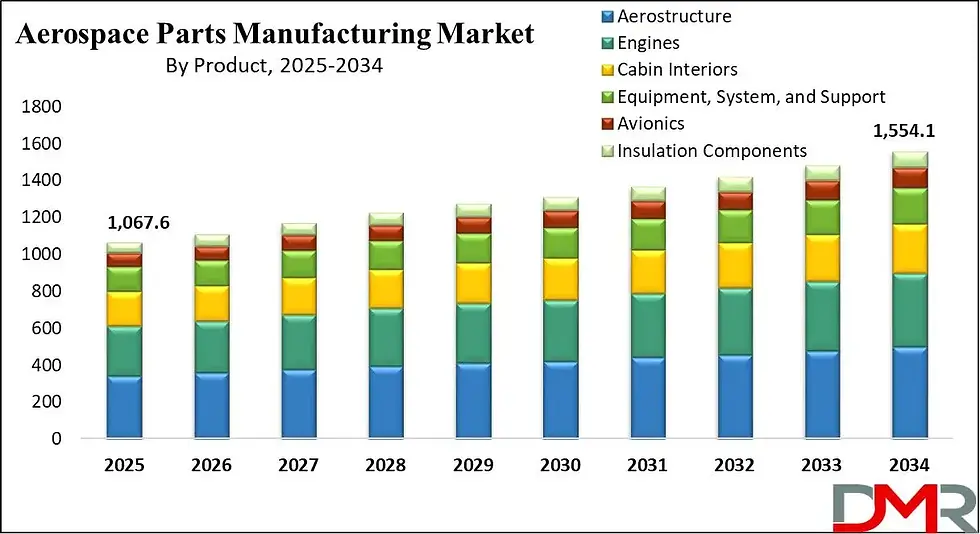
The global Aerospace Parts Manufacturing Market is valued at approximately USD 1,067.6 billion in 2025 and is projected to reach USD 1,554.1 billion by 2034, registering a compound annual growth rate (CAGR) of 4.3% over the forecast period from 2025 to 2034. The market is experiencing steady growth driven by rising air travel demand, increased defense spending, and the ongoing requirement for fleet modernization and replacement of aging aircraft.

Aerospace parts manufacturing involves the production of components for commercial airplanes, military aircraft, space exploration vehicles, and unmanned aerial systems. These parts include airframe structures, engine components, avionics systems, landing gear, and interior fittings. The sector plays an essential role in ensuring global aviation safety, operational efficiency, and technological progress.
The growing need for fuel-efficient aircraft, lightweight composite materials, and additive manufacturing techniques is transforming production methods. Airlines and defense organizations are increasingly seeking innovative parts that lower weight, reduce maintenance expenses, and extend service life.
Definition and Market Significance
Aerospace parts manufacturing refers to the design, production, assembly, and testing of components used in aircraft, spacecraft, helicopters, and related defense platforms. It requires precision engineering, rigorous quality assurance, and adherence to international aviation regulatory standards.
The significance of aerospace parts manufacturing lies in its direct influence on flight safety, operational performance, and environmental footprint. High-quality components ensure dependable aircraft operation, decrease fuel usage, and lower emissions. The industry also sustains millions of skilled jobs and drives innovation in material science, robotics, and digital manufacturing.
Aerospace parts manufacturing also supports the broader aviation ecosystem, enabling airlines, cargo operators, and military forces to maintain safe, efficient, and cost-effective operations.
Market Drivers
A primary factor propelling the Aerospace Parts Manufacturing Market is the growing volume of global air passenger and cargo traffic. Increasing disposable incomes, tourism growth, and e-commerce expansion are pushing airlines to enlarge and modernize their fleets.
The necessity to replace aging aircraft fleets serves as another key driver supporting market expansion. Older airplanes are less fuel-efficient and more expensive to maintain, prompting airlines to invest in next-generation models equipped with advanced components.
Rising defense budgets across numerous countries are also contributing to market growth. Modernization of military aircraft fleets, procurement of fighter jets, and investments in unmanned aerial vehicles (UAVs) require large quantities of specialized aerospace parts.
Market Trends
The adoption of additive manufacturing (3D printing) for producing complex aerospace components is emerging as a notable trend in the industry. This technology reduces material waste, shortens production lead times, and enables lightweight part designs.
Another significant trend is the increasing utilization of advanced composite materials such as carbon fiber reinforced polymers. These materials provide excellent strength-to-weight ratios, improving fuel efficiency and lowering lifecycle costs.
The integration of digital twins and Industry 4.0 technologies in manufacturing facilities is also reshaping aerospace parts production. Real-time monitoring, predictive maintenance, and automated quality control enhance productivity and reduce defects.
Market Restraints
Despite its consistent growth potential, the aerospace parts manufacturing market faces certain obstacles. One of the primary challenges is the stringent regulatory certification process that new components must undergo before entering service.
High research and development expenses associated with advanced materials and manufacturing techniques may also slow innovation, particularly for smaller suppliers.
In addition, supply chain disruptions caused by geopolitical tensions, raw material shortages, or logistics bottlenecks can affect production schedules and increase costs.
Market Opportunities
The rapid expansion of space exploration programs, including satellite deployments and commercial space travel, is creating substantial growth opportunities for aerospace parts manufacturers. Components for launch vehicles, satellites, and space habitats represent a new frontier.
Developing economies in Asia Pacific and the Middle East are also showing increased interest in establishing local aerospace manufacturing capabilities, supported by government incentives and foreign direct investment.
Furthermore, the growing aftermarket for replacement parts, repairs, and upgrades offers a consistent revenue stream for manufacturers that can provide certified, high-quality components throughout an aircraft's operational life.
Segmentation
The Aerospace Parts Manufacturing Market is categorized based on product type, material, end user, platform, and region.
By product type, engine parts are expected to dominate the segment with approximately 32% of the total market share by 2025, driven by the critical role of engines in aircraft performance and maintenance cycles.
By material, aluminum alloys are projected to maintain a leading share due to their favorable strength-to-weight ratio and cost-effectiveness, though composites are gaining ground.
By end user, commercial aviation is expected to account for the largest share, supported by rising passenger traffic and airline fleet expansion plans.
By platform, fixed-wing aircraft (commercial and military) represent the dominant category, while helicopters and unmanned aerial vehicles are growing steadily.
Regional Analysis

North America is predicted to lead the aerospace parts manufacturing market with a 51.7% revenue share by 2025, due to significant investments made into advanced manufacturing technology and its highly qualified labor pool. Aging aircraft fleets present an ideal economic climate for aircraft manufacturing companies as airlines needing to maintain efficient operations must replace older models to maintain efficiency and revenue stability.
Europe holds a substantial share of the aerospace parts manufacturing market, driven by the presence of major aircraft manufacturers, strong defense collaboration among member states, and investments in next-generation propulsion systems.
Asia Pacific is emerging as a fast-growing region in the aerospace parts manufacturing market. Countries such as China, India, Japan, and South Korea are expanding domestic production capabilities and attracting foreign investment through favorable policies.
Latin America is experiencing modest growth, with Brazil maintaining a regional aerospace manufacturing hub and other countries gradually developing maintenance and component production capabilities.
Middle East & Africa is gradually building aerospace parts manufacturing capacity, supported by government diversification strategies, airline growth, and investments in maintenance, repair, and overhaul (MRO) facilities.
Request the complimentary sample:
Competitive Landscape
The aerospace parts manufacturing market is highly competitive with numerous global and regional players focusing on technological innovation, strategic partnerships, and operational efficiency. Leading manufacturers are investing in automation, digital quality systems, and lightweight materials to strengthen their market position.
Many companies are also developing integrated supply chain solutions and aftermarket services to build long-term relationships with aircraft OEMs and airlines.
Technological Advancements
Rapid advancements in robotics, artificial intelligence, and non-destructive testing are transforming aerospace parts manufacturing. Automated fiber placement, robotic drilling, and AI-powered defect detection improve precision and reduce production time.
The development of hybrid electric propulsion components and hydrogen fuel system parts is also gaining momentum as the industry pursues net-zero emissions targets.
Consumer Adoption Patterns
Commercial airlines and defense agencies are increasingly adopting advanced aerospace components that offer lower lifecycle costs, improved fuel economy, and enhanced reliability. The growing availability of performance-based logistics contracts is making advanced parts more accessible to operators worldwide.
Regulatory Environment
Aviation authorities such as the FAA (Federal Aviation Administration) and EASA (European Union Aviation Safety Agency) enforce strict certification standards for aerospace parts manufacturers. Compliance with AS9100 quality management systems and traceability requirements is mandatory for market participation.
Market Challenges
The aerospace parts manufacturing market faces challenges related to raw material price volatility, skilled labor shortages, and long product development cycles. The industry also contends with cyclical demand patterns tied to global economic conditions and travel disruptions.
Future Outlook
The future of the Aerospace Parts Manufacturing Market remains positive as commercial aviation rebounds, defense modernization continues, and space exploration accelerates. Increasing adoption of sustainable aviation fuels, electric propulsion, and lightweight structures is expected to drive demand for next-generation components throughout the forecast period.
FAQs
What is the expected size of the Aerospace Parts Manufacturing Market in 2025?
The market is estimated at USD 1,067.6 billion in 2025.
What is the projected market value by 2034?
The market is forecast to reach USD 1,554.1 billion by 2034.
What is the CAGR of the Aerospace Parts Manufacturing Market?
The market is expected to grow at a CAGR of 4.3% during 2025–2034.
Which region leads the global aerospace parts manufacturing market?
North America is predicted to lead with approximately 51.7% revenue share by 2025.
Which product type dominates the market?
Engine parts are expected to dominate with around 32% market share by 2025.
Summary of Key Insights
The global Aerospace Parts Manufacturing Market is valued at USD 1,067.6 billion in 2025 and is projected to reach USD 1,554.1 billion by 2034, recording a CAGR of 4.3% during the forecast period. Engine parts lead the product type segment with 32% share, while North America dominates regional share with 51.7% of global revenue by 2025. Commercial aviation remains the largest end-user segment, supported by fleet modernization and air traffic growth.
Purchase the Full Report: https://dimensionmarketresearch.com/checkout/aerospace-parts-manufacturing-market/



Comments