


Deep Brain Stimulation Devices Market Size, Share 2025-2034

Market Overview
According to Dimension Market Research, the Global Deep Brain Stimulation Devices Market is projected to reach USD 3.9 billion in 2025 and is expected to expand at a compound annual growth rate (CAGR) of 10.4% from 2025 to 2034, attaining a market value of approximately USD 9.4 billion by 2034. Market growth is primarily driven by the rising prevalence of neurological disorders such as Parkinson's disease, essential tremor, dystonia, epilepsy, and obsessive-compulsive disorder (OCD). Advancements in neurostimulation technology, including directional leads, closed-loop systems, and AI-enabled programming algorithms, are enhancing therapeutic precision and patient outcomes.
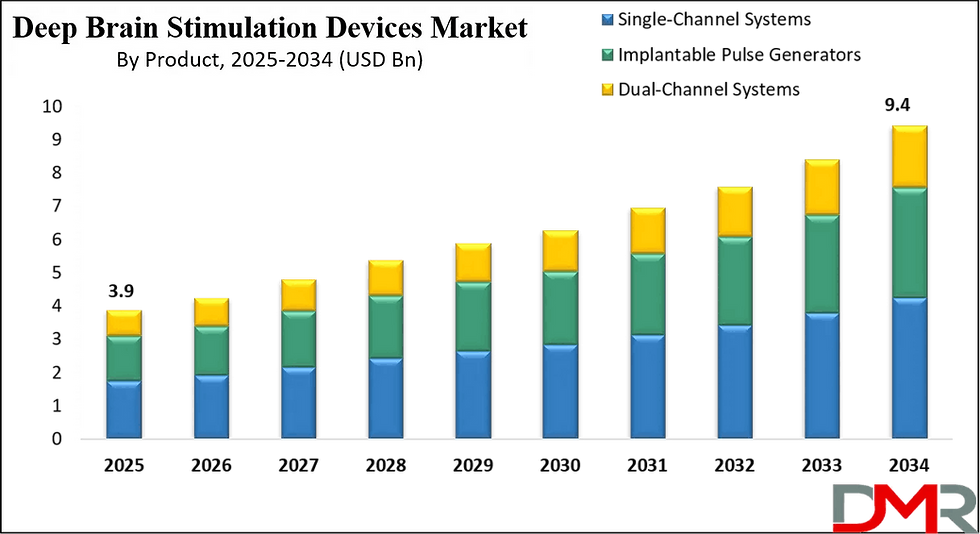
Furthermore, increasing adoption of minimally invasive neurosurgical procedures, growing investments in brain-computer interface research, and expanding availability of MRI-compatible and rechargeable DBS systems are fueling market expansion. The surge in geriatric populations, improved reimbursement frameworks, and the growing use of DBS for psychiatric and movement disorders further reinforce the long-term growth outlook of the global market.
The global landscape for Deep Brain Stimulation (DBS) devices is characterized by a trajectory of robust expansion, fueled by the escalating prevalence of neurological disorders and continuous technological refinement. A prominent trend involves the development of directional leads and current-steering technology, which allows for more precise targeting of neural structures. This enhanced precision mitigates side effects and expands the therapeutic window for conditions like Parkinson's disease and essential tremor.
Significant opportunities for market proliferation lie in the exploration of new neurological and psychiatric indications. Clinical trials are actively investigating the efficacy of DBS for conditions such as treatment-resistant depression, obsessive-compulsive disorder, and epilepsy. Success in these areas would substantially broaden the addressable patient population beyond traditional movement disorders.
Definition and Market Significance
Deep Brain Stimulation (DBS) devices are implantable neurostimulation systems that deliver controlled electrical impulses to specific targets within the brain to treat neurological and psychiatric disorders. These systems consist of leads implanted in the brain, an implantable pulse generator (IPG) placed under the skin near the collarbone, and extension wires connecting the two, along with external programming devices used by clinicians to adjust stimulation parameters.
The importance of DBS devices lies in their ability to provide significant symptom relief for patients with movement disorders such as Parkinson's disease, essential tremor, and dystonia when medications are no longer effective or cause intolerable side effects. DBS can dramatically improve quality of life, restore motor function, and reduce disability.
DBS devices also support broader medical innovation by enabling research into brain function, facilitating the development of closed-loop and adaptive neuromodulation systems, and expanding therapeutic applications into psychiatric and neurological conditions such as treatment-resistant depression, OCD, and epilepsy.
Looking for Something Specific? Get Free Sample:
https://dimensionmarketresearch.com/request-sample/deep-brain-stimulation-dbs-devices-market/
Market Drivers
A major factor driving the Deep Brain Stimulation Devices Market is the global demographic shift towards an aging population. The most powerful and consistent growth driver for the DBS market is the inexorable global demographic transition towards an older population. Age stands as the single greatest risk factor for neurodegenerative diseases such as Parkinson's disease and essential tremor. As life expectancy increases worldwide, the prevalence of these chronic, progressive conditions rises in direct correlation. This expanding patient base creates a sustained and growing demand for effective long-term treatment options that go beyond pharmacotherapy.
Substantial public and private investment in neuroscience is another key driver supporting market expansion. Substantial and sustained public and private investment in foundational neuroscience research serves as a critical catalyst for market advancement. Government-funded initiatives, such as the National Institutes of Health's BRAIN Initiative in the United States, allocate significant resources to understanding complex brain circuits and developing next-generation neurotechnology. This foundational research directly fuels innovation in DBS, leading to the discovery of new stimulation targets and the creation of more sophisticated device architectures.
The rising prevalence of neurological disorders, growing awareness of advanced treatment options, and improving reimbursement frameworks are also contributing to market growth, as healthcare systems increasingly recognize the long-term cost-effectiveness of DBS therapy.
Market Trends
The proliferation of directional lead technology and current steering is emerging as an important trend in the market. The market is undergoing a significant transformation with the widespread adoption of directional leads and current fractionalization. Departing from traditional cylindrical leads, these advanced systems enable clinicians to precisely steer electrical current toward specific neural targets while meticulously avoiding stimulation of adjacent areas that induce side effects. This capability substantially widens the therapeutic window, delivering superior symptom control for movement disorders while concurrently mitigating risks to speech and balance.
Another significant trend is the integration of advanced neuroimaging and data analytics. A dominant trend is the deep integration of sophisticated neuroimaging and data analytics into the entire DBS workflow. The utilization of high-field MRI and connectomics is revolutionizing surgical planning, shifting it from a purely anatomy-based to a connectivity-based approach. Post-operatively, the constant collection of brain signal data and stimulation parameters from the implanted device generates vast datasets that hold the promise of identifying objective biomarkers for disease progression and autonomously optimizing stimulation algorithms.
The development of adaptive closed-loop systems, rechargeable implantable pulse generators, and miniaturized device components is also transforming the market, addressing key patient concerns regarding convenience and longevity.
Market Restraints
Despite its strong growth potential, the Deep Brain Stimulation Devices Market faces certain limitations. High procedural and long-term cost burden poses significant challenges. The high overall cost of DBS therapy presents a significant barrier to widespread adoption, particularly in cost-sensitive healthcare environments and developing nations. The expense encompasses not only the high price of the implantable hardware but also the substantial costs associated with the complex neurosurgical procedure, the requisite hospital stay, and the ongoing, long-term post-operative programming and neurological management.
Without comprehensive insurance coverage or government reimbursement, this therapy remains inaccessible to a large portion of the potential patient population.
Inherent risks of invasive neurosurgery are another significant restraint. The DBS procedure carries inherent and serious risks associated with invasive brain surgery, which can deter both potential patients and their referring neurologists.
These material risks include the potential for intracranial hemorrhage, stroke, infection, and inaccurate lead placement, any of which could lead to permanent neurological deficits. The perception of these risks, combined with the irreversibility of the surgical intervention, can slow referral rates and patient acceptance.
In addition, stringent and lengthy regulatory approval processes for new devices and indications act as a brake on the pace of innovation and market entry for new competitors.
Market Opportunities
Expansion into new therapeutic indications presents significant growth opportunities. A major growth frontier lies in the expansion of DBS into novel therapeutic areas beyond established movement disorders. There is active and promising clinical research exploring the efficacy of DBS for severe, treatment-resistant psychiatric conditions, including major depressive disorder and obsessive-compulsive disorder. Success in these areas would unlock a vast patient population that currently has very limited therapeutic options. Furthermore, ongoing investigations for conditions like epilepsy, using responsive neurostimulation systems, represent a paradigm shift from continuous to on-demand brain modulation.
Development of adaptive closed-loop systems is another promising opportunity. The development and commercialization of closed-loop or adaptive DBS systems present a monumental technological and commercial opportunity. Unlike current open-loop systems that deliver constant, pre-set stimulation, adaptive DBS can sense a patient's unique and fluctuating neural signals and automatically adjust stimulation parameters in real time. This "smart" form of neuromodulation promises to maximize therapeutic benefits while simultaneously minimizing side effects and extending the battery life of the implanted device.
Furthermore, the integration of artificial intelligence for precision targeting, personalized programming, and predictive analytics for patient selection and outcomes is expected to open new opportunities for market participants.
Segmentation
The Deep Brain Stimulation Devices Market is categorized based on product, application, and end user.
By product, the dual-channel systems segment is projected to dominate the global market and is expected to maintain this leadership position. This dominance is fundamentally rooted in clinical efficacy and the bilateral nature of most neurological disorders treated with DBS. Conditions like Parkinson's disease, essential tremor, and dystonia typically affect both sides of the body. A dual-channel system allows for the simultaneous and independent stimulation of both the left and right hemispheres of the brain, which is crucial for achieving comprehensive symptom control.
By application, the Parkinson's disease segment is poised to be the unequivocal leader in the application category. This dominance is driven by a confluence of factors: a high and growing prevalence, robust clinical validation, and well-established reimbursement pathways. Decades of extensive clinical research and long-term studies have irrefutably proven the efficacy of DBS in managing the key motor symptoms of Parkinson's, such as tremor, rigidity, and bradykinesia, particularly when patients begin to experience significant "off" periods and dyskinesias from medication.
By end user, hospitals and clinics are anticipated to constitute the dominant end-user segment. The dominance of this channel is inherent to the complex, highly specialized, and resource-intensive nature of the DBS procedure. The implantation of a DBS system is a sophisticated neurosurgical operation that requires a state-of-the-art operating room, advanced neuroimaging equipment for precise lead placement, and a multidisciplinary team. The long-term management of a patient with a DBS device requires continuous oversight by trained neurologists in a clinical setting.
Regional Analysis
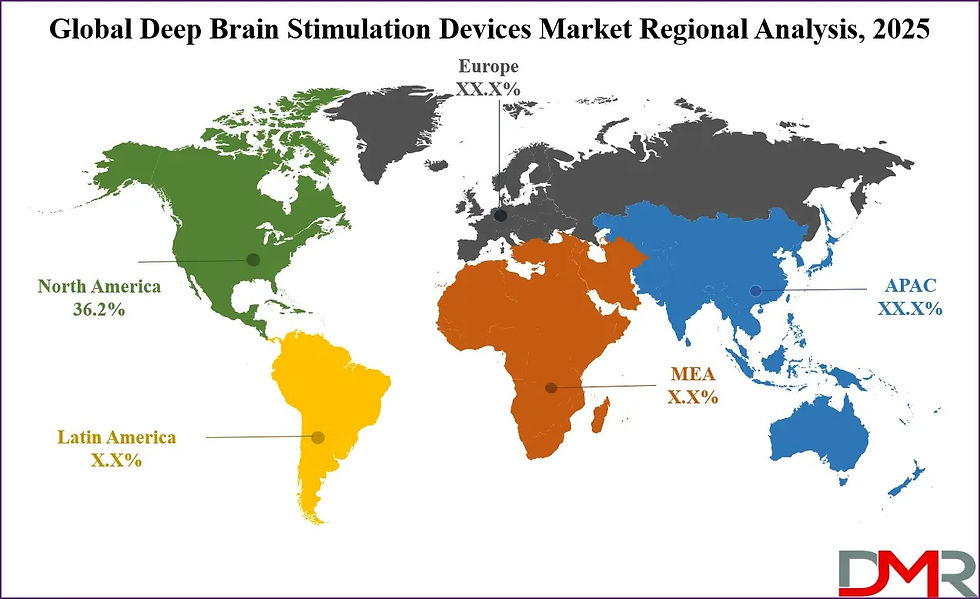
North America, led by the United States, is expected to command 36.2% of the global Deep Brain Stimulation devices market share in 2025, due to a powerful convergence of technological, economic, and clinical factors. The region benefits from a high prevalence of neurological disorders, with the National Institute of Neurological Disorders and Stroke (NINDS) estimating nearly one million people in the U.S. living with Parkinson's disease alone. This creates a substantial and well-defined patient pool. Furthermore, the region's advanced healthcare infrastructure, characterized by leading academic medical centers and specialized neurology practices, facilitates the complex DBS procedure. Critically, robust reimbursement frameworks from both private insurers and government programs like Medicare and Medicaid provide a clear economic pathway for hospitals and patients. The US market is projected to be valued at USD 1.2 billion in 2025, reaching USD 2.7 billion in 2034 at a CAGR of 9.8%.
Europe holds a substantial share of the DBS devices market, estimated to be valued at USD 585 million in 2025 and anticipated to reach USD 1,170 million by 2034 at a CAGR of 8.0%. Europe's DBS device market is a mature and sophisticated landscape, shaped by its advanced public healthcare systems and a rapidly aging demographic profile. Data from Eurostat confirms that Europe has one of the oldest populations in the world, with a steadily increasing old-age dependency ratio. Market dynamics across the continent are influenced by the centralized regulatory oversight of the European Medicines Agency (EMA), which, in conjunction with the new Medical Device Regulation (MDR), provides a harmonized framework for the approval and monitoring of high-risk medical devices.
Asia Pacific is projected to exhibit the highest Compound Annual Growth Rate (CAGR) in the DBS market, driven by explosive demographic, economic, and infrastructural expansion. The primary catalyst is the rapidly aging population in key countries like Japan and China, which directly correlates with a rising incidence of age-related neurodegenerative diseases such as Parkinson's. Concurrently, strong economic growth across the region is translating into increased healthcare spending, greater disposable income, and the gradual expansion of public and private health insurance coverage. Japan's market is projected to be valued at USD 234 million in 2025, reaching USD 509 million in 2034 at a CAGR of 8.8%.
Latin America and the Middle East & Africa are gradually adopting DBS devices as healthcare infrastructure improves and awareness of advanced treatment options grows, with Brazil, Mexico, the UAE, and Saudi Arabia emerging as key markets.
Competitive Landscape
The global Deep Brain Stimulation devices market is characterized by a consolidated competitive landscape, dominated by a few established medical technology giants, yet it is experiencing a dynamic shift with the entry of innovative challengers. Medtronic plc, Abbott Laboratories (acquired St. Jude Medical), and Boston Scientific Corporation are the longstanding key players, collectively holding a significant market share. Their dominance is rooted in extensive product portfolios, robust clinical evidence supporting their devices, and well-established global distribution and sales networks.
Prominent players include Medtronic, Boston Scientific, Abbott (St. Jude Medical), Aleva Neurotherapeutics, NeuroPace, Beijing PINS Medical, SceneRay, Renishaw, LivaNova, Newronika, Synaptic Medical (Shenzhen), Alpha Omega Engineering, AlphaDBS Solutions (Deep Brain Innovations), NeuroSigma, Nexstim, BrainsWay, Adaptive Neuromodulation, Soterix Medical, CorTec, and Synchron. Recent developments include Boston Scientific's ACCELERATE trial positive one-year results (May 2024), Medtronic's pivotal clinical trial for treatment-resistant major depressive disorder (February 2024), Abbott's real-world evidence confirming sustained long-term effectiveness of directional DBS systems (January 2024), Boston Scientific's Japanese regulatory approval for its Vercise DBS platform (October 2023), and Aleva Neurotherapeutics securing significant new venture funding (August 2023).
Technological Advancements
Rapid advancements in artificial intelligence, directional lead technology, closed-loop systems, and advanced neuroimaging are transforming the Deep Brain Stimulation devices market. Artificial Intelligence algorithms are revolutionizing surgical planning by analyzing pre-operative MRI and CT scans to create highly detailed 3D brain maps, allowing surgeons to identify the optimal trajectory and target for electrode placement with sub-millimeter accuracy.
AI is the core enabler of the next generation of DBS: adaptive or closed-loop systems. These "smart" devices use embedded algorithms to continuously analyze a patient's local field potentials (LFPs), the brain's real-time electrical signals. The AI can detect the neural signatures of symptom onset and automatically adjust stimulation in response, providing therapy only when needed. Machine learning models are also being trained on vast datasets of clinical, genetic, and neuroimaging data to predict which patients are most likely to respond positively to DBS therapy.
Consumer Adoption Patterns
Patients with advanced Parkinson's disease, essential tremor, dystonia, and other movement disorders are increasingly adopting DBS devices when medications prove insufficient. The growing availability of MRI-compatible and rechargeable systems, along with improved reimbursement coverage, is expanding access to DBS therapy across diverse patient populations. Emerging applications in psychiatric conditions such as treatment-resistant depression and OCD are expected to further broaden adoption.
Regulatory Environment
Regulatory frameworks across different regions, including FDA approval pathways in the United States, EMA and MDR requirements in Europe, and PMDA oversight in Japan, significantly influence the DBS devices market. These regulations govern device safety, efficacy, and clinical validation, shaping product development and market access. Favorable reimbursement decisions from agencies like CMS in the U.S. and national health services in Europe are critical for ensuring patient access.
Market Challenges
The DBS devices market faces challenges related to high procedural and long-term costs, inherent risks of invasive neurosurgery, lengthy regulatory approval processes, and the need for specialized clinical expertise. Additionally, addressing patient and physician concerns about surgical risks, ensuring long-term device reliability, and expanding access in developing healthcare systems remain ongoing challenges.
Future Outlook
The future of the Deep Brain Stimulation Devices Market remains highly promising as the global population ages and the prevalence of neurological disorders continues to rise. Increasing adoption of directional lead technology, development of adaptive closed-loop systems, expansion into new therapeutic indications, and growing investment in neuroscience research are expected to drive strong market growth during the forecast period, with the market projected to reach USD 9.4 billion by 2034 at a CAGR of 10.4%.
FAQs
What is the expected size of the Deep Brain Stimulation Devices Market in 2025? The market is expected to reach USD 3.9 billion in 2025.
What is the projected market value by 2034? The market is forecast to reach USD 9.4 billion by 2034.
What is the CAGR of the Deep Brain Stimulation Devices Market? The market is expected to grow at a CAGR of 10.4% during 2025–2034.
Which product segment dominates the market? Dual-channel systems are projected to dominate the market.
Which region leads the global DBS devices market? North America is expected to command 36.2% of the global market share in 2025.
Summary of Key Insights
The global Deep Brain Stimulation Devices Market is expected to grow from USD 3.9 billion in 2025 to USD 9.4 billion by 2034, recording a CAGR of 10.4% during the forecast period. Dual-channel systems lead the product segment, while Parkinson's disease dominates applications. Hospitals and clinics constitute the dominant end-user segment. North America holds the largest regional share with 36.2% of global revenue in 2025, while Asia Pacific is projected as the fastest-growing region. The US market is projected to reach USD 2.7 billion by 2034 at a CAGR of 9.8%.
Purchase the Full Report: https://dimensionmarketresearch.com/checkout/deep-brain-stimulation-dbs-devices-market/

Comments