


Grafted Polyolefins Market Comprehensive Analysis
- James Anderson
- May 28
- 6 min read

Market Overview
The global Grafted Polyolefins Market size is valued at USD 1.9 billion in 2024 and is anticipated to reach USD 2.9 billion by 2033, progressing at a CAGR of 5.0% over the forecast period. This consistent expansion is being supported by the increasing utilization of functionalized polyolefins across high-performance industrial applications where improved adhesion, compatibility, and mechanical reinforcement are essential. Rising demand from automotive, packaging, construction, and electrical industries is further reinforcing market momentum.
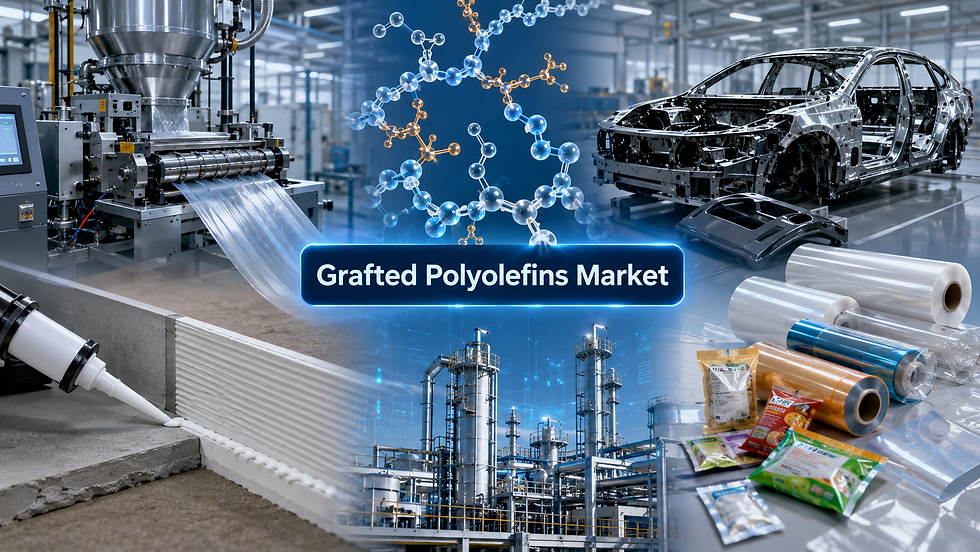
The market is steadily advancing due to the growing adoption of grafted polyolefins as compatibilizing agents in multi-polymer systems, where they significantly enhance interfacial bonding between incompatible materials. These materials play a crucial role in improving mechanical strength, thermal stability, and durability of end-use products. In addition, the shift toward lightweight engineering materials and recyclable polymer solutions is accelerating their usage across multiple sectors globally.
Ongoing developments in polymer processing technologies and chemical modification techniques are enabling manufacturers to produce more efficient and application-specific grafted polyolefins. Increasing emphasis on material performance optimization and sustainability in manufacturing processes is further strengthening market adoption. As industries move toward advanced polymer engineering solutions, grafted polyolefins are becoming an essential component in modern material design.
Market Dynamics
Drivers
The expansion of the grafted polyolefins market is primarily fueled by rising demand from the automotive industry, where lightweight materials are increasingly used to enhance fuel efficiency and reduce emissions. These materials are widely incorporated in vehicle interior and exterior components to improve adhesion between different polymer types and enhance structural durability. The packaging industry also contributes significantly, with growing demand for multilayer films and flexible packaging solutions requiring strong interlayer bonding.
Additionally, the construction sector is witnessing higher adoption of adhesives, sealants, and modified polymer systems that require improved bonding performance and long-term reliability. The electrical and electronics industry is also supporting demand growth due to the need for high-performance insulating and protective materials. The global shift toward sustainable production practices and recyclable materials further enhances the adoption of grafted polyolefins across industries.
Restraints
The market is constrained by volatility in raw material prices, particularly for polyethylene and polypropylene derivatives, which directly impacts manufacturing costs. Another limiting factor is the complexity involved in maintaining consistent grafting efficiency during large-scale production, which can affect product quality and performance uniformity.
In addition, competition from alternative compatibilizers and polymer modification additives creates pricing pressure in cost-sensitive applications. Limited awareness and slower adoption rates in developing regions further restrict market expansion, especially where polymer processing technologies are less advanced.
Opportunities
Growing interest in sustainable and bio-based polymer solutions presents strong opportunities for market expansion. Manufacturers are increasingly focusing on eco-friendly grafted polyolefins that combine performance efficiency with reduced environmental impact. The expanding electric vehicle industry is also creating new avenues for application, particularly in lightweight structural components and battery-related systems.
Furthermore, the rise of advanced packaging technologies, including high-barrier and smart packaging solutions, is expected to increase demand for high-performance compatibilizers. Rapid industrialization in emerging economies across Asia-Pacific, Latin America, and Africa is also opening significant untapped growth potential for advanced polymer materials.
Market Segmentation Analysis
The grafted polyolefins market is divided by type, application, and end-use industry, each segment contributing uniquely to overall market growth. By type, maleic anhydride grafted polyolefins dominate the market due to their excellent compatibility with a wide range of polar polymers and their extensive industrial applicability. Acrylic acid grafted and other functionalized variants are also utilized in specialized applications requiring tailored performance characteristics.
Based on application, the market includes compatibilizers, adhesives, sealants, films, coatings, and specialty polymer modifiers. Compatibilizers hold a significant share as they enable effective blending of incompatible polymers, improving structural integrity and performance. Adhesives and sealants also account for a considerable portion of demand due to widespread usage in automotive assembly, construction, and industrial manufacturing. Film applications continue to expand with the growth of multilayer packaging systems requiring enhanced bonding and barrier properties.
From an end-use industry perspective, automotive remains a leading consumer of grafted polyolefins, driven by increasing lightweighting initiatives and demand for high-strength composite materials. The packaging sector is another major contributor, supported by the expansion of flexible packaging and food safety applications. Construction, electrical & electronics, and consumer goods industries are also steadily adopting these materials for improved durability, performance, and thermal resistance.
Technology Landscape and Innovation Trends
Technological progress in grafted polyolefins is focused on enhancing grafting precision, improving material consistency, and increasing functional performance. Reactive extrusion technology is widely adopted as it enables continuous processing and better control over functional group incorporation, resulting in improved scalability and efficiency.
Innovation is also being driven by advancements in catalyst systems and polymer modification techniques that enhance product stability and performance. The integration of nanotechnology into polymer systems is enabling improvements in strength, thermal resistance, and barrier functionality. Additionally, digital manufacturing systems and process automation are improving production accuracy and reducing material inconsistencies.
Application Outlook
The application scope of grafted polyolefins is expanding across multiple industrial sectors. In automotive manufacturing, they are used in interior trims, bumpers, dashboards, and structural components where strong polymer bonding is essential. Their ability to improve impact resistance and reduce overall vehicle weight makes them highly valuable in modern automotive design.
In packaging, these materials are widely used in multilayer films, flexible packaging structures, and protective coatings that require strong adhesion between different polymer layers. The construction industry utilizes grafted polyolefins in adhesives, sealants, and waterproofing systems that demand long-lasting durability. Electrical and electronic applications rely on them for insulation layers, protective coatings, and cable jacketing solutions.
Regional Analysis
North America leads the global market, accounting for approximately 34.1% of total revenue in 2024. This dominance is supported by strong industrial infrastructure, advanced manufacturing capabilities, and significant investment in research and development activities. The presence of leading polymer manufacturers and established supply chains further strengthens regional market leadership.
Europe holds a notable share of the market, driven by strict environmental standards, strong automotive production, and increasing demand for sustainable polymer solutions. Asia-Pacific is projected to witness the fastest growth due to rapid industrial expansion, rising automotive production, and strong packaging demand in countries such as China and India. Latin America and the Middle East & Africa are emerging regions supported by increasing industrial development and growing adoption of advanced polymer technologies.
Download Complimentary PDF Sample Report
FAQs
1. What are grafted polyolefins primarily used for?
They are mainly used to enhance compatibility between different polymers and improve adhesion in automotive, packaging, adhesive, and coating applications.
2. What factors are driving market growth?
Growth is driven by rising automotive lightweighting demand, expansion of packaging applications, and increasing use of advanced polymer materials across industries.
3. Which product type dominates the market?
Maleic anhydride grafted polyolefins dominate due to their superior bonding performance and wide industrial compatibility.
4. Which region leads the market globally?
North America leads the market due to strong manufacturing capabilities, high R&D investment, and presence of major industry players.
5. What are the major challenges faced by the market?
Raw material price fluctuations, process complexity, and competition from alternative materials are key challenges.
Competitive Landscape and Strategic Developments
The market is highly competitive, with manufacturers focusing on innovation, capacity expansion, and strategic collaborations. Companies are investing heavily in research and development to improve grafting efficiency, enhance product performance, and expand application-specific solutions. Partnerships with automotive OEMs, packaging firms, and construction material producers are increasing to develop customized polymer solutions.
In addition, companies are expanding production capabilities and strengthening global distribution networks to meet rising demand. The increasing emphasis on sustainability is also encouraging the development of bio-based and environmentally friendly grafted polyolefins aligned with global environmental standards.
Future Market Outlook
The grafted polyolefins market is expected to maintain stable growth over the forecast period, supported by increasing demand for high-performance polymer materials across industries. Continuous advancements in polymer chemistry, along with expanding applications in automotive, packaging, and electronics, will drive long-term market development. The shift toward sustainable materials is also expected to play a key role in shaping future trends.
Summary of Key Insights
The market is experiencing steady growth driven by automotive lightweighting, packaging innovation, and increasing industrial demand for compatibilizers. North America remains the leading region, while Asia-Pacific presents strong future growth potential. Technological advancements in polymer modification and reactive processing are expected to further enhance market expansion.



Comments