


Lubricant Additives Market Outlook 2023–2032
- James Anderson
- May 16
- 4 min read

Market Overview
The global Lubricant Additives Market is estimated to reach a value of USD 18.5 billion in 2023 and is projected to grow further to USD 27.7 billion by 2032, registering a CAGR of 4.6% over the forecast period 2023–2032.

Lubricant additives are specialized chemical components blended into base oils to enhance the functional performance, durability, and stability of lubricants used across automotive, industrial, and marine applications. These compounds help improve key properties such as oxidation resistance, viscosity control, anti-wear protection, corrosion prevention, and thermal stability, enabling efficient machinery operation and longer equipment lifespan.
The market growth is primarily supported by the expansion of automotive production, increasing industrial activities, and rising demand for high-performance lubrication solutions. Additionally, the global shift toward fuel-efficient engines and low-emission technologies is further accelerating the adoption of advanced lubricant additive formulations.
Definition and Market Significance
Lubricant additives are performance-enhancing chemical substances added to lubricating oils to improve their operational characteristics under varying mechanical and environmental conditions. These include detergents, dispersants, antioxidants, anti-wear agents, viscosity modifiers, and friction-reducing compounds.
The importance of this market is rooted in its ability to improve machinery efficiency, reduce operational downtime, and lower maintenance costs. By minimizing friction, preventing component wear, and improving thermal resistance, lubricant additives significantly contribute to energy efficiency and equipment longevity across multiple industrial sectors.
Market Drivers
The expansion of the automotive sector is a key factor driving the lubricant additives market, as higher vehicle production and usage increase lubricant consumption requirements.
Rapid industrial growth, especially in emerging economies, is also boosting demand for efficient lubricants used in heavy-duty machinery and manufacturing equipment.
Growing emphasis on energy efficiency and emission reduction is encouraging the development of advanced lubricant formulations that enhance engine performance while reducing fuel usage.
In addition, the rising need for improved equipment reliability and reduced maintenance expenses across industries such as construction, mining, and marine is further supporting market growth.
Market Trends

A notable trend in the market is the increasing shift toward low-viscosity and energy-efficient lubricant formulations aimed at improving fuel economy and reducing environmental impact.
The rising adoption of synthetic and bio-based lubricants is also influencing additive development, with manufacturers focusing on compatibility, sustainability, and performance optimization.
Another emerging trend is the use of customized additive packages designed for specific industrial applications to maximize operational efficiency.
Continuous advancements in chemical engineering are enabling the creation of multifunctional additives that deliver enhanced protection and longer service life.
Market Restraints
Volatility in raw material prices, particularly petroleum-based inputs, remains a major challenge affecting market stability and production costs.
Strict environmental regulations concerning chemical usage and emissions are also limiting the use of certain additive formulations.
Additionally, the growing adoption of electric vehicles, which require significantly fewer lubricants compared to traditional combustion engines, may restrain long-term market demand.
Market Opportunities
The expansion of industrial infrastructure in developing regions presents strong growth potential for lubricant additive manufacturers.
Rising demand for high-performance lubricants in sectors such as aerospace, wind energy, and marine is opening new application avenues.
The development of environmentally friendly and bio-based additive solutions aligned with sustainability goals is expected to create significant future opportunities.
Segmentation
The lubricant additives market is categorized by type, application, and end-use industry. Detergents and dispersants hold a major share due to their essential role in maintaining engine cleanliness and efficiency.
By application, automotive lubricants dominate the market owing to high global vehicle production and usage levels.
Industrial applications also represent a key segment, driven by the need for reliable machinery performance and optimized maintenance cycles.
Regional Analysis
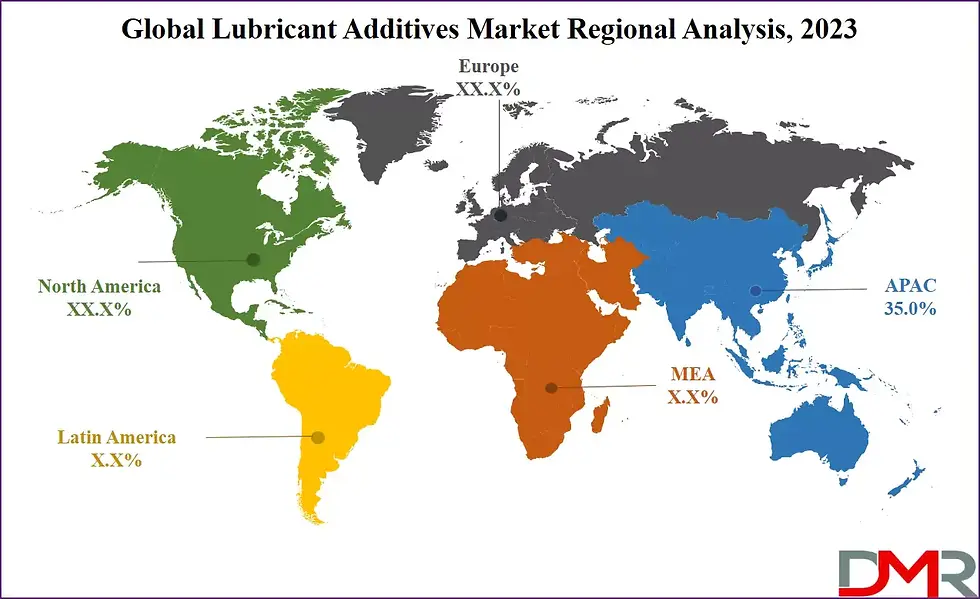
North America
North America maintains a strong presence in the lubricant additives market, supported by advanced automotive technologies, high industrial output, and strict environmental regulations encouraging efficient lubricant use.
Europe
Europe shows steady market development driven by stringent emission standards and the increasing adoption of high-efficiency and sustainable lubricant solutions across automotive and industrial sectors.
Asia-Pacific
Asia-Pacific leads the global lubricant additives market, holding 35.0% of the market share in 2023. The region dominates both production and consumption due to rapid industrialization, strong automotive manufacturing growth, and continuous economic expansion in countries such as China and India.
Latin America
Latin America is experiencing gradual growth supported by rising industrial activities and increasing demand for automotive and manufacturing applications, particularly in Brazil and Mexico.
Middle East & Africa
The Middle East & Africa region is steadily expanding, driven by infrastructure development and increasing demand for industrial machinery and transportation services.
Download a Complimentary PDF Sample Report
Competitive Landscape
The lubricant additives market is highly competitive, with leading companies focusing on innovation, strategic collaborations, and capacity expansion. Key players include Chevron Oronite, Infineum International, Afton Chemical, Lubrizol Corporation, and BASF SE. Continuous research and development efforts remain central to improving product performance and sustainability.
Technological Advancements
Ongoing progress in chemical formulation technologies is enabling the development of advanced multifunctional additive systems. Innovations in synthetic chemistry and nano-scale additives are further improving lubrication efficiency and durability.
Consumer Adoption Patterns
Adoption of lubricant additives is increasing across automotive and industrial sectors due to rising demand for fuel efficiency, lower emissions, and extended machinery lifespan. Industrial users are increasingly opting for customized additive solutions tailored to specific operational requirements.
Regulatory Environment
Stringent environmental regulations governing emissions and chemical safety are shaping product development strategies across the industry. Compliance with global regulatory standards is essential for market participation and long-term growth.
Market Challenges
Key challenges include fluctuations in raw material prices, rising compliance costs, and the gradual transition toward electric mobility. These factors may influence future demand patterns.
Future Outlook
The lubricant additives market is projected to maintain stable growth, supported by industrial expansion, technological advancements, and increasing demand for high-performance lubrication solutions. Sustainability-driven innovations are expected to play a critical role in shaping future market dynamics.
FAQs
What is the lubricant additives market?
It refers to the industry focused on chemical compounds used to enhance the performance of lubricating oils.
What is the market size of lubricant additives?
USD 18.5 billion in 2023, expected to reach USD 27.7 billion by 2032.
What is the CAGR of the market?
4.6% during the period 2023–2032.
Which region leads the market?
Asia-Pacific dominates with a 35.0% share in 2023.
What are the key growth factors?
Rising automotive production, industrial expansion, and demand for efficient lubricants.
Summary of Key Insights
The lubricant additives market is steadily expanding, driven by automotive growth, industrial development, and increasing demand for high-efficiency lubricants. Asia-Pacific remains the leading region, while sustainability trends and technological innovation continue to shape future opportunities.
Purchase the report for comprehensive details



Comments