


Second Life EV Battery Market Outlook 2026–2035
- James Anderson
- May 14
- 5 min read

Market Overview
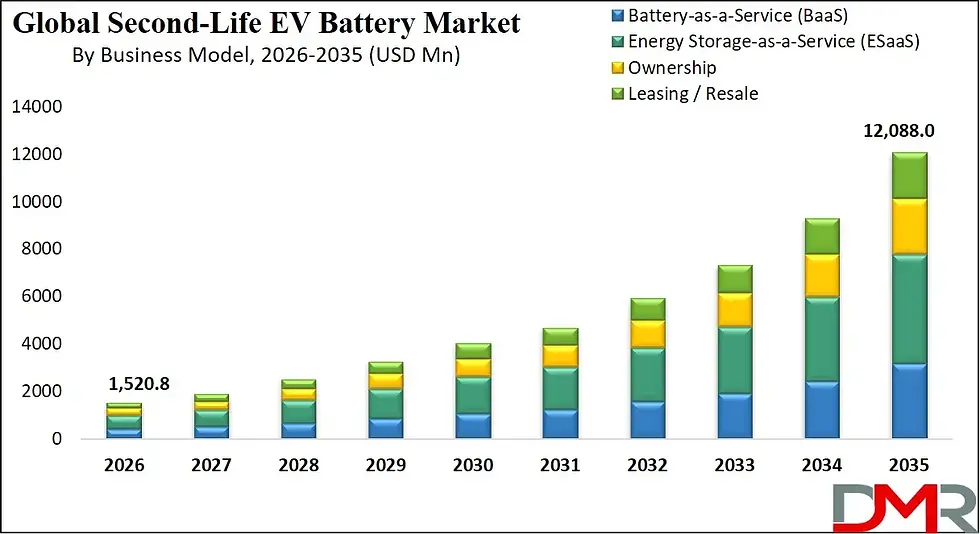
The global Second Life EV Battery Market is projected to reach a value of USD 1,520.8 million in 2026 and is further expected to attain USD 12,088.0 million by 2035, expanding at a CAGR of 25.9% during the forecast period 2026–2035.

The second-life EV battery market involves the repurposing of electric vehicle batteries that have reached the end of their automotive service life for secondary applications such as stationary energy storage, grid support, renewable energy integration, and backup power systems. Although these batteries are no longer optimal for vehicle use, they still retain usable capacity, making them suitable for less demanding energy storage applications.
The market is witnessing strong expansion driven by the rapid increase in electric vehicle adoption, which is generating a growing pool of end-of-life batteries available for reuse. Simultaneously, the global transition toward renewable energy and the need for stable grid infrastructure are boosting demand for affordable and scalable storage solutions. Continuous improvements in battery assessment technologies, repurposing processes, and lifecycle management systems are further enhancing the feasibility of second-life applications.
Definition and Market Significance
Second-life EV batteries refer to lithium-ion battery packs that are removed from electric vehicles once their performance declines below automotive requirements but still retain sufficient capacity for alternative uses. These batteries are refurbished, reconfigured, and redeployed for stationary energy storage purposes.
The importance of this market is rooted in its contribution to sustainability and resource optimization. It extends the usable life of battery systems, reduces electronic waste, and supports circular economy initiatives. At the same time, it offers a more economical alternative to newly manufactured energy storage systems, enabling faster and more cost-efficient deployment of renewable energy infrastructure.
Market Drivers
The increasing penetration of electric vehicles worldwide is a major factor driving the availability of used battery packs suitable for second-life applications.
Rising deployment of renewable energy projects such as solar and wind power is also fueling demand for energy storage systems capable of balancing supply fluctuations and grid instability.
The cost advantage of repurposed batteries compared to new energy storage technologies is encouraging adoption among utilities and energy developers.
Additionally, government initiatives promoting sustainability, battery reuse, and circular economy practices are further supporting market growth.
Market Trends
One prominent trend is the growing deployment of repurposed EV batteries in utility-scale energy storage systems for peak load management and grid stabilization.
Strategic collaborations among automotive manufacturers, energy companies, and recycling firms are also becoming increasingly common in the ecosystem.
AI-driven battery health evaluation and advanced diagnostic tools are improving accuracy in determining remaining battery life and optimal reuse applications.
Moreover, hybrid storage systems combining renewable energy sources with second-life batteries are gaining traction across multiple regions.
Market Restraints
Differences in battery condition and degradation levels after EV usage create challenges in ensuring uniform performance standards.
High costs associated with inspection, refurbishment, and certification processes can reduce overall profitability in certain cases.
Regulatory uncertainty regarding safety guidelines and end-of-life battery handling also restricts large-scale adoption in some markets.
Market Opportunities
The expansion of renewable energy infrastructure presents strong opportunities for integrating second-life batteries into large-scale storage systems.
Emerging economies are expected to offer significant growth potential due to rising electricity demand and limited access to high-cost energy storage solutions.
Ongoing technological advancements in battery diagnostics and automated repurposing systems are likely to improve scalability and reduce operational costs.
Segmentation
The second-life EV battery market is categorized by application, battery type, and end-use. Energy storage systems dominate the application segment due to increasing requirements for grid stability and renewable energy integration.
Lithium-ion batteries lead the market by type, driven by their widespread use in electric vehicles and relatively high residual capacity after automotive use.
Utilities and renewable energy operators are the primary end-users, supported by large-scale energy storage requirements.
Regional Analysis
North America
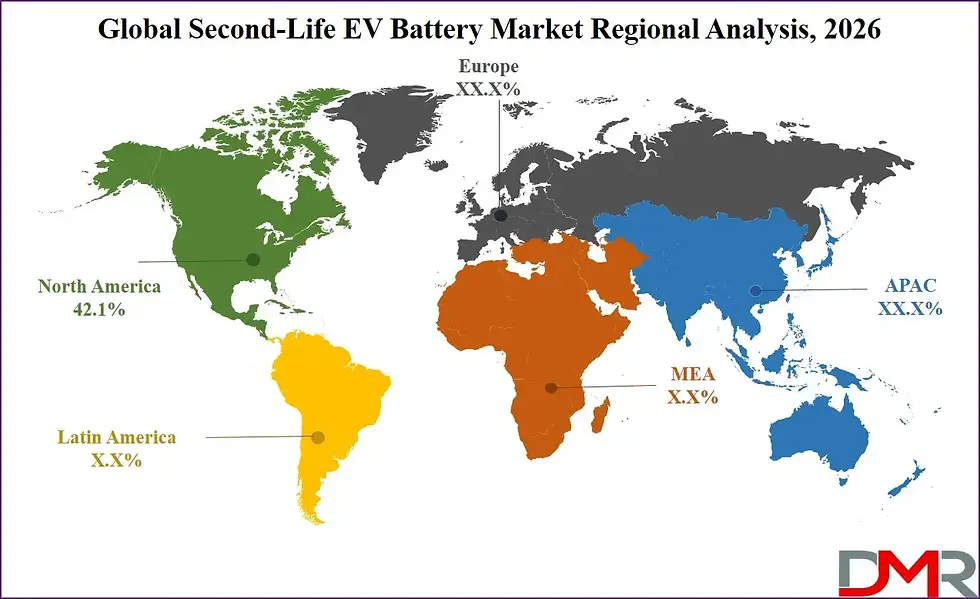
North America is expected to lead the global second-life EV battery market with a 42.1% share in 2026. This dominance is supported by a large volume of end-of-life EV batteries, particularly from early Tesla models and first-generation electric vehicles. Strong demand for energy storage in states such as California and New York further strengthens regional growth. The region also benefits from a well-developed ecosystem of battery recyclers, dismantlers, and energy storage startups, along with advanced technical expertise in power systems engineering.
Europe
Europe is experiencing strong market expansion driven by strict environmental regulations and a strong emphasis on circular economy and sustainability initiatives. Continuous investment in battery reuse infrastructure is further supporting regional growth.
Asia-Pacific
Asia-Pacific is projected to witness rapid growth due to large-scale EV manufacturing, increasing renewable energy installations, and supportive government policies, particularly in China, Japan, and South Korea.
Latin America
Latin America is gradually adopting second-life battery solutions, supported by expanding renewable energy projects and increasing demand for reliable power supply in remote regions.
Middle East & Africa
The Middle East & Africa region is emerging in this market, driven by diversification of energy sources and growing investments in off-grid renewable energy storage systems.
Download a Complimentary PDF Sample Report
Competitive Landscape
The second-life EV battery market features strong collaboration between automotive OEMs, energy providers, and recycling companies. Market participants focus on improving repurposing technologies, enhancing battery lifecycle management, and expanding large-scale storage applications. Key companies include Tesla, Nissan, BMW, LG Energy Solution, along with several emerging startups in the battery reuse and recycling sector.
Technological Advancements
Advancements in battery state-of-health diagnostics, AI-based predictive modeling, and automated repurposing systems are significantly improving operational efficiency. Innovations in modular energy storage architecture are also simplifying integration into grid-scale systems.
Consumer Adoption Patterns
Adoption is rising among utilities, renewable energy developers, and industrial energy consumers seeking affordable and sustainable storage solutions. Demand is particularly strong in regions with high renewable penetration and increasing grid balancing requirements.
Regulatory Environment
Regulatory frameworks focused on sustainability, battery reuse, and safety compliance are shaping market development. Standardization of repurposing processes and certification protocols is becoming increasingly important for commercial scalability.
Market Challenges
Key challenges include variability in battery quality, lack of standardized refurbishment processes, and evolving regulatory requirements. Ensuring safety, reliability, and performance consistency remains a major concern for market participants.
Future Outlook
The second-life EV battery market is expected to expand rapidly over the forecast period, supported by accelerating EV adoption and rising demand for sustainable energy storage solutions. Continued innovation and supportive policy frameworks will further drive commercialization and large-scale deployment.
FAQs
What is the second-life EV battery market?
It refers to the reuse of electric vehicle batteries for secondary applications such as energy storage after their automotive lifecycle ends.
What is the market size in 2026?
USD 1,520.8 million in 2026.
What is the projected market value by 2035?
USD 12,088.0 million by 2035.
What is the CAGR of the market?
25.9% during 2026–2035.
Which region dominates the market?
North America holds the leading position with a 42.1% share in 2026.
Summary of Key Insights
The second-life EV battery market is expanding at a strong pace, driven by rising electric vehicle penetration, increasing renewable energy integration, and growing demand for economical energy storage systems. North America remains the leading region, while other markets are expected to show significant growth potential over the forecast period.
Purchase the report for comprehensive details


Comments