


Virtual Tourism Market Outlook 2025–2034
- James Anderson
- May 11
- 7 min read

Market Overview
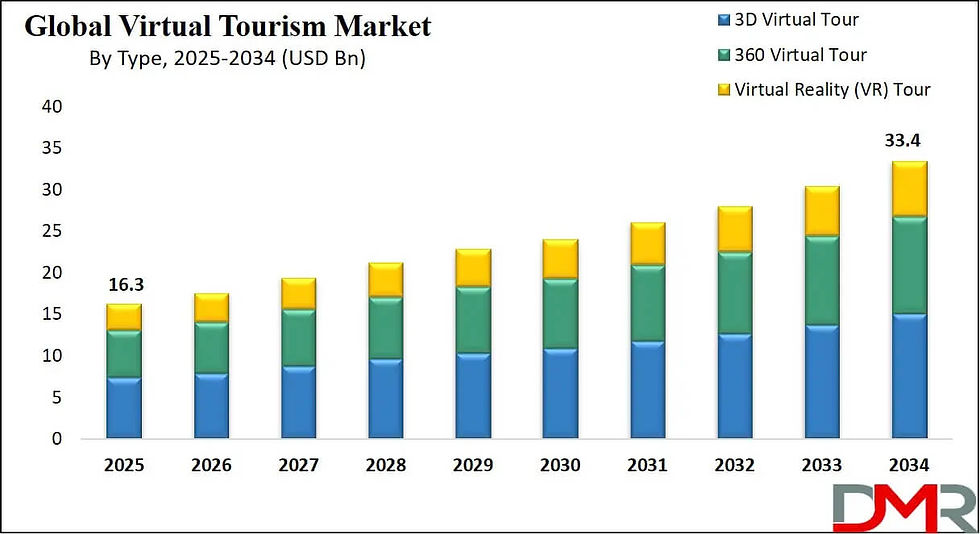
The global Virtual Tourism Market is anticipated to attain a valuation of USD 16.3 Bn in 2025 and is further forecasted to reach USD 33.4 Bn by 2034, expanding at a CAGR of 8.3% throughout the forecast period.
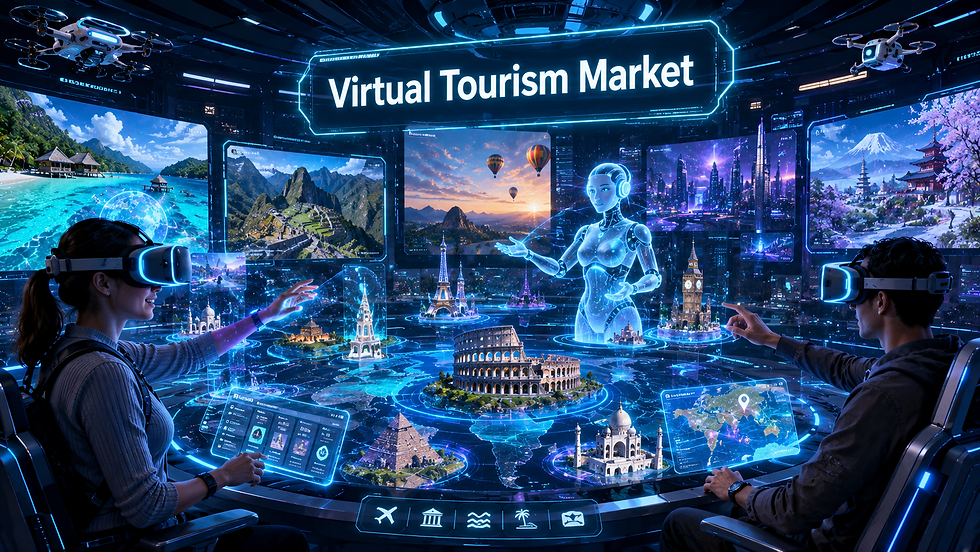
Virtual tourism represents a digitally enabled travel experience powered by technologies such as virtual reality (VR), augmented reality (AR), 360-degree videos, interactive simulations, and 3D visualization platforms. These technologies allow users to virtually discover tourist attractions, historical landmarks, museums, and cultural destinations without physically traveling to those locations.
The increasing penetration of immersive digital technologies is reshaping the global tourism landscape by enabling consumers to engage with destinations in highly interactive and realistic ways. Rising demand for virtual travel experiences across tourism, hospitality, education, and entertainment industries is significantly contributing to market growth. The availability of affordable VR devices, high-speed internet infrastructure, and advanced mobile technologies is further supporting industry expansion.
Additionally, virtual tourism is emerging as an environmentally sustainable alternative to traditional travel, helping reduce carbon emissions while improving accessibility for global audiences. Tourism boards, museums, and cultural institutions are increasingly investing in digital transformation initiatives to preserve and showcase heritage sites through immersive virtual experiences.
Definition and Market Significance
Virtual tourism refers to the use of immersive digital technologies to simulate real-world travel experiences within a virtual environment. It utilizes advanced technologies including VR, AR, computer-generated imagery, photogrammetry, and artificial intelligence to deliver realistic and interactive tourism experiences.
The market is highly significant as it transforms the way consumers explore destinations and engage with travel-related content. Virtual tourism enhances accessibility for users who may face physical, geographical, or financial barriers to travel while also supporting sustainable tourism development and global cultural accessibility.
Market Drivers
The expansion of the virtual tourism market is largely fueled by rapid technological advancements in virtual reality, augmented reality, and immersive media solutions. The growing accessibility of VR headsets, smartphones, and high-speed internet services is accelerating user engagement with virtual tourism platforms.
Increasing consumer preference for immersive and personalized digital experiences is encouraging tourism companies and content providers to develop interactive virtual travel solutions. The growing influence of the metaverse and digital entertainment ecosystems is also creating new opportunities for virtual tourism applications.
Furthermore, governments and tourism organizations are investing in digital heritage preservation projects and virtual destination showcases to attract global audiences. The increasing incorporation of virtual tours within educational programs and remote learning environments is also contributing to market growth.
Market Trends
A major trend shaping the market is the integration of artificial intelligence into virtual tourism platforms to offer customized travel experiences and AI-powered virtual assistants.
The demand for immersive 3D environments and VR-enabled destination experiences is growing rapidly across tourism, hospitality, education, and entertainment sectors. Advanced technologies such as spatial audio, real-time rendering, and interactive simulations are enhancing the realism and engagement levels of virtual experiences.
Another emerging trend is the development of metaverse-based tourism environments where users can virtually visit destinations, participate in digital cultural events, and interact socially in immersive ecosystems.
The rising emphasis on sustainable tourism practices is also encouraging the adoption of virtual travel experiences as eco-friendly alternatives to physical travel.
Market Restraints
Despite promising growth prospects, the market faces challenges related to the high costs associated with developing sophisticated immersive tourism content and virtual environments.
Certain users continue to experience discomfort and motion sickness while using VR devices, which may hinder adoption rates. Limited internet connectivity and inadequate digital infrastructure in developing regions also restrict access to high-quality virtual tourism
experiences.
Additionally, concerns regarding data security, prolonged digital screen exposure, and lack of universal standards for immersive content quality present challenges for industry growth.
Market Opportunities
The rapid growth of metaverse ecosystems and immersive social platforms is creating substantial opportunities for virtual tourism providers worldwide.
Increasing adoption of virtual learning platforms and digital educational experiences is opening new avenues for virtual tourism applications across schools, universities, and training institutions.
The integration of AI-driven personalization, multilingual virtual assistants, and interactive storytelling capabilities is expected to significantly enhance user engagement and commercial value.
Growing investments in smart tourism infrastructure, immersive entertainment platforms, and cultural heritage digitization initiatives are also expected to create lucrative market opportunities during the forecast period.
Segmentation
The Virtual Tourism market is segmented based on type, product type, technology, suppliers, application, and end use.
By type, 3D virtual tours account for the leading market share due to their ability to provide highly immersive and realistic exploration experiences. These solutions are extensively utilized by museums, tourism authorities, hotels, and educational organizations.
360 virtual tours are experiencing notable growth owing to rising adoption in tourism promotion and digital destination marketing strategies.
Virtual reality (VR) tours are also gaining significant traction due to increasing consumer interest in immersive digital entertainment and metaverse experiences.
By product type, cloud-based solutions dominate the market because of their scalability, flexibility, and accessibility across multiple devices and platforms.
By technology, 3D scanning and imaging technologies hold a substantial market share owing to their extensive use in the development of realistic virtual environments and heritage preservation projects.
By application, the tourism sector remains the dominant segment, followed by museums and art galleries that increasingly leverage immersive technologies to improve visitor interaction and accessibility.
Regional Analysis

North America
North America is projected to maintain a leading position in the Virtual Tourism market with a share of 37.1% in 2025. The region benefits from advanced digital infrastructure, high consumer adoption of immersive technologies, and the strong presence of leading technology companies. Continuous innovation in VR and AI technologies is further strengthening regional market growth.
Europe
Europe is witnessing increasing adoption of virtual tourism solutions driven by extensive investments in cultural heritage digitization and smart tourism initiatives. Countries including Germany, France, and Italy are actively integrating immersive experiences into museums, tourism destinations, and cultural institutions.
Asia-Pacific
Asia-Pacific is emerging as the fastest-growing regional market due to rapid urbanization, rising internet penetration, and growing adoption of immersive technologies across countries such as China, India, Japan, and South Korea. Expanding digital entertainment ecosystems and increasing consumer demand for virtual experiences are fueling regional growth.
Latin America
Latin America is gradually expanding its presence in the virtual tourism market supported by improving digital infrastructure and rising interest in online tourism experiences. Increasing use of immersive technologies for tourism marketing is also contributing to regional development.
Middle East & Africa
The Middle East & Africa region is experiencing steady market growth driven by digital transformation initiatives, rising investment in tourism infrastructure, and increasing adoption of smart tourism technologies.
Download a Complimentary PDF Sample Report
Competitive Landscape
The Virtual Tourism market is characterized by strong competition among technology providers, VR platform developers, immersive content creators, and tourism technology companies.
Market participants are focusing on enhancing immersive capabilities through artificial intelligence integration, advanced rendering technologies, and next-generation VR hardware solutions. Strategic collaborations between tourism boards, technology firms, and cultural institutions are also shaping market competition.
Companies are increasingly investing in cloud-based immersive platforms, interactive storytelling systems, and metaverse-compatible experiences to improve user engagement and expand global reach.
Technological Advancements
Innovations in virtual reality, augmented reality, 3D visualization, spatial audio, and AI-driven personalization technologies are significantly enhancing immersive tourism experiences.
Developments in cloud computing, haptic feedback systems, and real-time rendering engines are enabling the creation of scalable and highly interactive digital environments.
Artificial intelligence and machine learning technologies are also improving destination recommendations, automated narration systems, and multilingual virtual travel assistance.
Consumer Adoption Patterns
Consumers are increasingly utilizing virtual tourism platforms for entertainment, educational learning, destination planning, and cultural exploration purposes.
Younger demographics, particularly Millennials and Gen Z consumers, represent a major share of virtual tourism users due to their strong engagement with immersive digital technologies.
Museums, tourism organizations, hospitality providers, and educational institutions are also rapidly adopting virtual tourism platforms to improve accessibility and audience interaction.
Regulatory Environment
Governments and tourism authorities across multiple regions are supporting virtual tourism initiatives through digital transformation programs and cultural heritage digitization strategies.
Regulations related to digital accessibility, cybersecurity, and data privacy are becoming increasingly important as immersive tourism platforms continue to expand globally.
Authorities are also promoting ethical use of artificial intelligence and secure digital interactions within virtual tourism ecosystems.
Market Challenges
One of the major challenges facing the market is the high cost involved in producing advanced immersive tourism content and maintaining realistic digital environments.
Technical limitations including VR hardware compatibility, motion-related discomfort, and high bandwidth requirements continue to impact user experience.
Ensuring data security, maintaining content quality standards, and delivering consistent user engagement remain critical challenges for market participants.
Future Outlook
The Virtual Tourism market is expected to experience substantial expansion through 2034 driven by continuous advancements in immersive technologies, artificial intelligence, and metaverse ecosystems.
The growing integration of virtual tourism platforms into entertainment, education, hospitality, and cultural preservation initiatives is expected to further broaden market opportunities worldwide.
The convergence of VR, AI, cloud computing, and interactive digital ecosystems is anticipated to reshape the future of global tourism experiences.
FAQs
What is the Virtual Tourism Market?
It refers to the industry focused on delivering immersive digital travel experiences using technologies such as VR, AR, 360-degree video, and interactive virtual environments.
What is the market size in 2025 and 2034?
The market is expected to reach USD 16.3 Bn in 2025 and USD 33.4 Bn by 2034.
What is the CAGR of the market?
The market is projected to grow at a CAGR of 8.3% during the forecast period of 2025–2034.
Which region dominates the market?
North America dominates the market with a 37.1% share in 2025.
What are the key growth drivers?
Major growth drivers include increasing adoption of VR technologies, rising demand for immersive digital experiences, expansion of metaverse ecosystems, and advancements in AI-powered tourism platforms.
Summary of Key Insights
The Virtual Tourism Market is witnessing strong growth due to increasing adoption of immersive technologies, rising digital content consumption, and expanding use of virtual experiences across tourism, education, and entertainment sectors. The market is projected to grow from USD 16.3 Bn in 2025 to USD 33.4 Bn by 2034 at a CAGR of 8.3%.
North America leads the market with a 37.1% share, while Asia-Pacific is emerging as a rapidly growing region. Technological advancements, metaverse integration, and increasing investments in digital tourism infrastructure are major factors supporting global market expansion.
Purchase the report for comprehensive details


Comments