


Voice Recognition Security Market worth $199.2 Bn by 2034

Market Overview
According to Dimension Market Research, the Global Voice Recognition Security Market is predicted to be valued at USD 20.7 billion in 2025 and is expected to grow to USD 199.2 billion by 2034, registering a compound annual growth rate (CAGR) of 28.6% from 2025 to 2034. The market is experiencing explosive expansion due to increasing demand for secure and user-friendly authentication methods across financial institutions, healthcare providers, and government agencies, rising incidents of identity theft and cyberattacks, and widespread adoption of smart devices and virtual assistants.
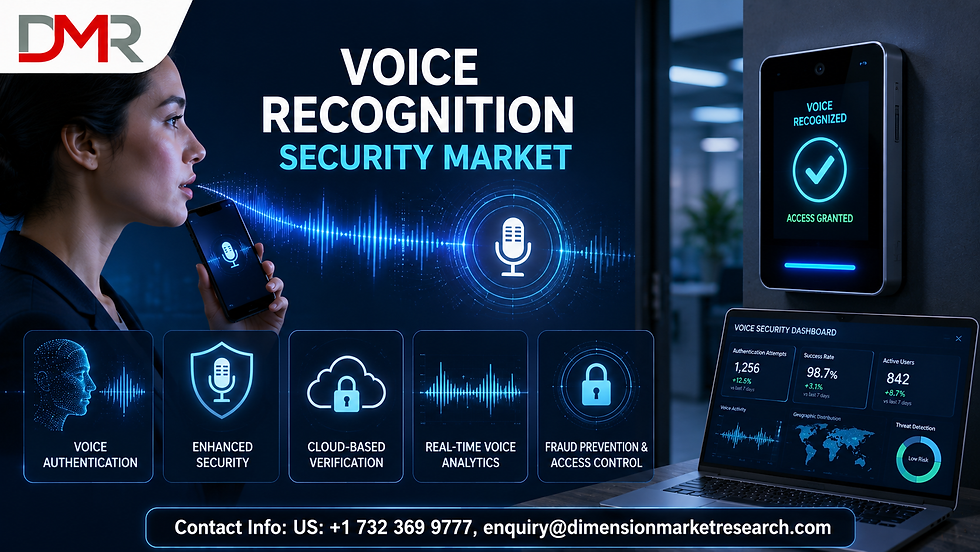
Voice recognition security technologies are becoming vital for organizations aiming to implement robust, contactless authentication that enhances user experience while reducing fraud. These systems utilize artificial intelligence, machine learning, and natural language processing to verify identity through unique voiceprints, enabling secure access to banking services, mobile applications, and enterprise networks.
The increasing requirement for fraud prevention and regulatory compliance is pushing financial institutions, telecom operators, and government agencies to invest in voice biometrics. Innovations such as liveness detection, deep learning algorithms, and multi-factor authentication integration are improving accuracy and security against spoofing attempts.
Furthermore, the growing emphasis on seamless customer experiences and digital transformation is speeding up the deployment of voice recognition security across mobile banking, call centers, smart home devices, and healthcare applications globally.
Definition and Market Significance
Voice recognition security refers to biometric authentication systems that verify an individual's identity by analyzing unique vocal characteristics, including pitch, tone, cadence, and pronunciation patterns. Technologies include automatic speech recognition, speaker verification, speaker identification, and natural language processing, deployed across active, passive, and multi-factor authentication frameworks.
The significance of voice recognition security lies in its capacity to provide convenient, contactless, and highly secure authentication that is difficult to spoof or replicate. Unlike passwords or PINs, voiceprints are unique to each individual and cannot be easily stolen or forgotten, offering a reliable alternative for identity verification.
Voice recognition security also supports broader digital identity and cybersecurity strategies, enabling organizations to reduce fraud, streamline customer interactions, and comply with regulatory requirements for strong authentication in banking, healthcare, and government services.
Market Drivers
A primary factor propelling the Voice Recognition Security Market is the growing demand for secure authentication in banking, financial services, and telecommunications. Financial institutions are implementing voice biometrics to ensure secure access, reduce fraud, and improve user experience, particularly in mobile banking and call center environments.
The rise in contactless and remote access technologies post-pandemic serves as another key driver supporting market expansion. Voice recognition offers a frictionless, hygienic, and user-friendly method for securing devices, networks, and critical data across healthcare, government, and enterprise IT.
Increasing incidents of identity theft and cyberattacks are also fueling market growth. Voice-based solutions provide a more reliable alternative to traditional passwords or PINs, with real-time user validation enhancing fraud detection in financial transactions and digital services.
Market Trends

The shift toward multi-modal biometric authentication is surfacing as an important trend in the market. Organizations are combining voice recognition with facial recognition, iris scans, or behavioral analytics to enhance security by addressing the limitations of single-mode authentication and reducing false positives.
Advancements in AI and deep learning algorithms are also significantly reshaping the voice recognition security landscape. AI-powered models are improving accuracy, speed, and adaptability of voice authentication systems, even in challenging acoustic environments, with modern systems distinguishing subtle voice characteristics and detecting spoofing attempts.
The growing adoption of voice recognition in smart devices and IoT ecosystems is another significant trend. Voice-enabled authentication is securing smart homes, wearable devices, and connected healthcare systems, meeting the need for secure, hands-free user authentication in home automation, voice-controlled appliances, and vehicle infotainment.
Market Restraints
Despite its strong growth potential, the voice recognition security market encounters certain limitations. One of the primary challenges is accuracy issues in noisy or uncontrolled environments, where external sound interference, background conversations, and poor microphone quality can result in false rejections or acceptance errors.
Privacy concerns and biometric data misuse pose significant challenges, as storing and managing biometric voiceprints raises legal and ethical questions around data breaches and unauthorized use. Unlike passwords, compromised biometric data cannot be changed, increasing the risk of long-term identity theft.
Additionally, high implementation costs of advanced voice recognition systems make adoption difficult for smaller organizations, while regulatory frameworks are still evolving, creating compliance uncertainty in some regions.
Market Opportunities
Government initiatives for biometric security infrastructure present significant growth opportunities. Biometric-based ID systems are being adopted for border control, voter verification, law enforcement, and social welfare distribution, with voice biometrics particularly useful in remote regions where other modalities may not be viable.
The integration of voice recognition technology with smart devices and IoT ecosystems offers another major opportunity. As IoT adoption increases across industries, the need for secure, hands-free, and seamless user authentication is growing, particularly in home automation, voice-controlled appliances, and vehicle infotainment.
Furthermore, the growing adoption of touchless biometric systems in post-pandemic digital infrastructure is expected to unlock new opportunities, as governments and enterprises prioritize frictionless access solutions in high-security zones, driving the adoption of voice-driven touchless systems in smart city protection structures and next-generation identification.
Segmentation
The Voice Recognition Security Market is categorized based on component, technology, authentication, application, end user, and region.
By component, the software segment is projected to lead with over 42.3% of the total revenue share in 2025, driven by increasing demand for advanced voice biometrics solutions in fraud prevention and secure access control.
By technology, automatic speech recognition is estimated to account for approximately 38.6% of the market share in 2025, supported by its use in secure voice-activated banking, smart assistants, and call center authentication.
By authentication, active voice authentication is expected to hold the largest share with approximately 45.8% in 2025, widely applied in banking and telecommunications for verbal identity verification.
By application, access control and authentication is estimated to occupy the highest share with approximately 36.9% in 2025, fueled by the growing use of voice-based user authentication in corporate networks and personal devices.
By end user, the banking, financial services, and insurance sector is estimated to dominate with 40.2% of the market share in 2025, as the industry increasingly incorporates voice biometrics for secure access and fraud prevention.
Regional Analysis
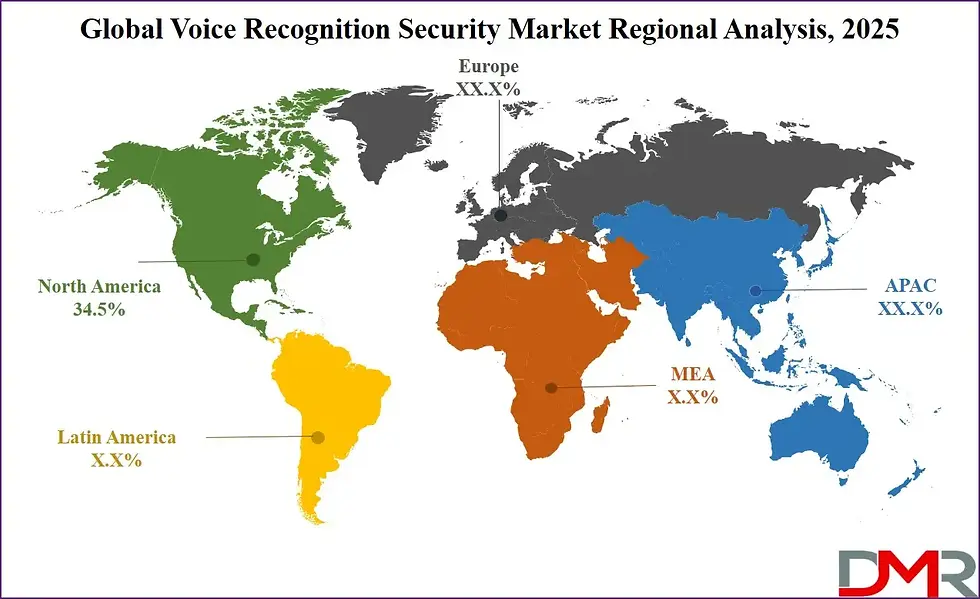
North America is expected to hold the largest share of the global voice recognition security market by the end of 2025, accounting for approximately 34.5% of the total market. This dominance is primarily driven by the region's robust technological infrastructure, high adoption of voice biometrics in sectors like banking, healthcare, and government, and a strong focus on cybersecurity. The United States leads within the region, with the US market projected to be valued at USD 6.0 billion in 2025 and expected to reach USD 50.9 billion by 2034 at a CAGR of 26.8%. Increasing use of voice recognition for fraud prevention, secure access control, and mobile authentication is particularly prominent in the U.S. and Canada.
Europe holds a substantial share of the voice recognition security market due to stringent data privacy regulations under the General Data Protection Regulation, growing awareness of cybersecurity, and rising adoption of contactless technologies in banking, insurance, and public services. The European market is projected to be valued at USD 4.8 billion in 2025 and reach USD 44.6 billion by 2034 at a CAGR of 27.8%.
Asia Pacific is predicted to register the highest CAGR in the global voice recognition security market by 2025. Rapid growth in emerging markets, particularly in China, India, and Japan, driven by increased smartphone penetration, growing demand for secure mobile payments, and contactless authentication, is accelerating adoption. Japan's market is projected to be valued at USD 1.9 billion in 2025 and reach USD 19.3 billion by 2034 at a CAGR of 29.1%.
Latin America is experiencing steady growth in voice recognition security adoption as digital banking and e-commerce expand, with increasing focus on fraud prevention and secure authentication in Brazil, Mexico, and Argentina.
Middle East & Africa is gradually adopting voice recognition technologies as governments invest in digital identity and cybersecurity infrastructure, particularly in the United Arab Emirates, Saudi Arabia, Israel, and South Africa.
Request a Complimentary PDF Sample
Competitive Landscape
The global voice recognition security market is marked by growing competition, with both established players and emerging companies striving to enhance technological capabilities. Leading vendors such as Nuance Communications, Verint Systems, NICE Ltd., Pindrop Security, Phonexia, LumenVox, Auraya Systems, Aware Inc., ID R&D, Voice Biometrics Group, Aculab, OneVault, LexisNexis Risk Solutions, Uniphore, ValidSoft, Daon Inc., BioCatch, Sensory Inc., SESTEK, and QSS Technosoft are at the forefront, focusing on integrating AI and machine learning into voice authentication systems.
Recent developments include SoundHound AI's introduction of Amelia 7.0 in May 2025, an advanced AI platform enabling autonomous agents through natural voice interactions, and their expanded collaboration with Nvidia to enhance performance and scalability of voice assistant technology. Apple's launch of the iPhone 16 series with improved Siri voice assistant further signifies the industry's commitment to integrating advanced AI features into devices.
Technological Advancements
Rapid advancements in deep learning algorithms, natural language processing, and liveness detection are transforming voice recognition security. AI-powered models now distinguish between subtle voice characteristics, detect spoofing attempts, and adapt to varying acoustic environments, improving accuracy and reliability.
Integration with multi-factor authentication frameworks and cloud-based platforms is also playing a significant role in modern voice security, enabling real-time verification across mobile devices, enterprise systems, and IoT ecosystems.
Consumer Adoption Patterns
Financial institutions, healthcare providers, government agencies, and telecom operators are increasingly adopting voice recognition security to reduce fraud, streamline customer verification, and enhance user experience. The growing demand for contactless and remote authentication in the post-pandemic digital landscape is accelerating adoption across sectors.
Regulatory Environment
Regulatory frameworks across different regions, including GDPR in Europe, state-level privacy laws in the U.S., and emerging biometric data protection regulations globally, shape the deployment of voice recognition security. Compliance with these regulations is driving investment in secure, transparent, and privacy-conscious biometric systems.
Market Challenges
The voice recognition security market faces challenges related to accuracy in noisy environments, privacy concerns, high implementation costs, and the evolving regulatory landscape. Additionally, the need for robust liveness detection to prevent spoofing and the complexity of integrating with legacy systems remain technical hurdles.
Future Outlook
The future of the Voice Recognition Security Market remains highly promising as the demand for secure, convenient, and contactless authentication continues to grow across industries. Advancements in AI-driven voice biometrics, integration with multi-modal authentication, expansion into IoT and smart device ecosystems, and increasing adoption in emerging economies are expected to drive strong market growth during the forecast period.
FAQs
What is the expected size of the Voice Recognition Security Market in 2025?
The market is expected to reach USD 20.7 billion in 2025.
What is the projected market value by 2034?
The market is forecast to reach USD 199.2 billion by 2034.
What is the CAGR of the Voice Recognition Security Market?
The market is expected to grow at a CAGR of 28.6% during 2025–2034.
Which component segment dominates the market?
The software segment is projected to dominate with over 42.3% share in 2025.
Which region leads the global voice recognition security market?
North America is expected to hold approximately 34.5% of the total market in 2025.
Summary of Key Insights
The global Voice Recognition Security Market is expected to grow from USD 20.7 billion in 2025 to USD 199.2 billion by 2034, recording a CAGR of 28.6% during the forecast period. Software leads the component segment with 42.3% share, while automatic speech recognition technology accounts for 38.6% share. Active voice authentication holds 45.8% share, and access control represents 36.9% of applications. The BFSI sector commands 40.2% of end-user demand. North America holds the largest regional share with 34.5%, while Asia Pacific registers the highest CAGR. The US market is projected to reach USD 50.9 billion by 2034.
Purchase the Full Report
Comments