


Charging as a Service Market Size, Share & Trends 2025-2034

Market Overview
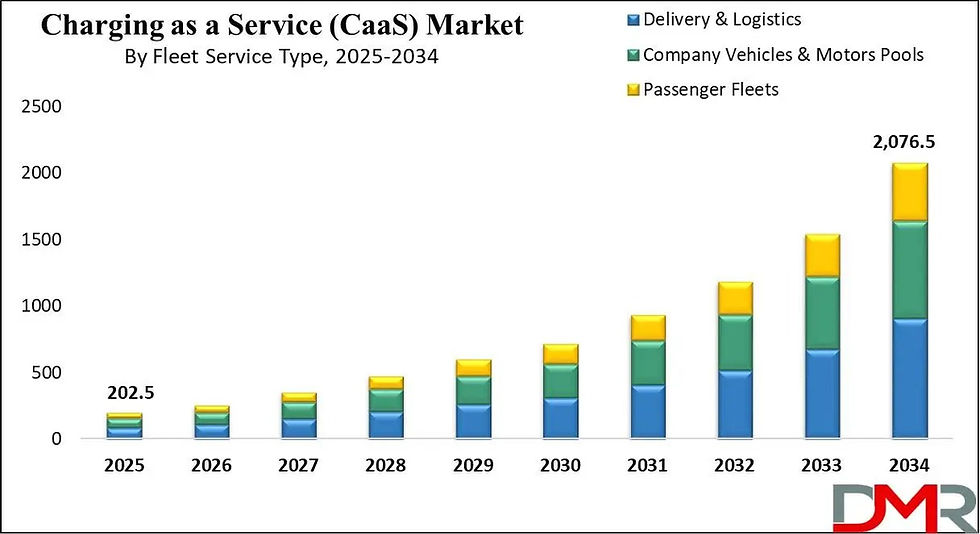
According to Dimension Market Research, the Global Charging as a Service Market is estimated to be valued at USD 202.5 million in 2025 and is further anticipated to reach USD 2,076.5 million by 2034 at a CAGR of 29.5%. The market is witnessing explosive growth due to the rapid expansion of electric vehicle adoption, growing demand for accessible and convenient charging infrastructure, rising investments in EV charging networks, and the shift toward subscription-based and pay-per-use charging models.
Charging as a Service (CaaS) is a business model that provides electric vehicle users with access to charging infrastructure without requiring them to own or maintain the equipment. Under this model, service providers install, operate, and manage charging stations, while customers pay for usage through subscription plans, pay-per-use fees, or bundled service packages. CaaS offerings typically include hardware installation, software platforms for managing charging sessions, payment processing, maintenance, and customer support.
The market is being driven by the increasing need for convenient and reliable charging solutions as EV adoption accelerates globally. Governments and private enterprises are investing heavily in charging infrastructure to support the transition to electric mobility, creating significant opportunities for CaaS providers. The integration of smart charging technologies, renewable energy sources, and vehicle-to-grid (V2G) capabilities is further enhancing the value proposition of CaaS offerings.
Moreover, the growing emphasis on sustainability and reducing carbon emissions is encouraging fleet operators, businesses, and municipalities to adopt CaaS solutions as a cost-effective and scalable approach to electrification.
Definition and Market Significance
Charging as a Service (CaaS) refers to a business model where electric vehicle charging infrastructure and related services are provided to users on a subscription, pay-per-use, or bundled basis, eliminating the need for upfront capital investment in charging equipment. CaaS providers handle installation, operation, maintenance, software management, and customer support, allowing users to focus on their core operations while enjoying reliable charging access.
The importance of CaaS lies in its ability to accelerate EV adoption by removing barriers related to charging infrastructure costs and complexity. For fleet operators, businesses, and individual consumers, CaaS offers a convenient, scalable, and cost-effective way to access charging services without the burden of ownership.
CaaS also supports broader sustainability and electrification goals by enabling the expansion of charging networks, integrating renewable energy sources, and facilitating smart charging solutions that optimize grid usage and reduce carbon emissions.
Request a Complimentary PDF Sample: https://dimensionmarketresearch.com/request-sample/charging-as-a-service-market/
Market Drivers
A major factor driving the Charging as a Service Market is the rapid expansion of electric vehicle adoption worldwide. As governments implement stricter emission regulations and consumers increasingly choose electric vehicles, the demand for accessible and reliable charging infrastructure has surged. CaaS providers address this need by offering flexible charging solutions that can be deployed quickly and scaled efficiently.
The growing demand for convenient and accessible charging infrastructure is another key driver supporting market expansion. EV users expect seamless charging experiences similar to traditional refueling, and CaaS providers deliver this through strategically located charging stations, user-friendly apps, and integrated payment systems.
Government incentives and investments in EV charging infrastructure are also contributing to market growth. Many countries have implemented policies, subsidies, and funding programs to accelerate the deployment of charging networks, creating a favorable environment for CaaS providers.
Market Trends
The integration of smart charging and renewable energy sources is emerging as an important trend in the CaaS market. Smart charging technologies enable dynamic management of charging sessions based on grid conditions, energy prices, and user preferences, while renewable energy integration allows charging stations to operate with minimal carbon footprint.
Another significant trend is the growth of subscription-based and bundled service models. CaaS providers are increasingly offering tiered subscription plans that include charging credits, priority access, and value-added services such as maintenance and roadside assistance, creating recurring revenue streams and enhancing customer loyalty.
The expansion of vehicle-to-grid (V2G) capabilities is also transforming the market, enabling EVs to serve as distributed energy resources that can supply power back to the grid during peak demand periods, creating new revenue opportunities for CaaS providers and fleet operators.
Market Restraints
Despite its strong growth potential, the Charging as a Service Market faces certain limitations. High upfront infrastructure costs pose a significant challenge, as deploying charging networks requires substantial investment in hardware, installation, and grid connection, which can be prohibitive for smaller providers.
Interoperability and standardization issues are another significant restraint. The lack of universal standards for charging connectors, payment systems, and communication protocols can create compatibility challenges and limit the seamless user experience that CaaS aims to provide.
In addition, grid capacity constraints in some regions can limit the deployment of high-power charging stations, requiring additional investment in grid upgrades and energy management solutions.
Market Opportunities
The expansion of fleet electrification presents a significant growth opportunity for the CaaS market. Logistics companies, delivery services, and public transportation operators are increasingly transitioning to electric fleets, creating demand for dedicated charging solutions that CaaS providers can deliver through tailored service packages.
The development of ultra-fast charging networks is another promising opportunity. As EV battery technology improves and consumer expectations for fast charging grow, CaaS providers that invest in high-power charging infrastructure can capture significant market share and enhance user satisfaction.
Furthermore, the integration of CaaS with smart city initiatives, renewable energy projects, and energy storage systems is expected to open new opportunities for the CaaS industry, enabling more sustainable and efficient charging ecosystems.
Segmentation
The Charging as a Service (CaaS) Market is categorized based on service type, charging type, application, and end user.
By service type, subscription-based services are expected to lead the market, offering predictable revenue for providers and convenient access for users. Pay-per-use services are also growing rapidly, particularly among individual EV owners and occasional users.
By charging type, AC charging is expected to dominate in residential and workplace settings due to its lower cost and suitability for overnight charging, while DC fast charging is projected to grow rapidly in public and commercial applications.
By application, public charging is expected to hold the largest share, driven by the expansion of charging networks in urban areas, highways, and commercial locations. Fleet charging is projected to be the fastest-growing segment, driven by the electrification of commercial vehicle fleets.
By end user, commercial fleet operators are expected to lead, followed by individual EV owners and government/municipal users.
Regional Analysis

In 2025, the global Charging as a Service (CaaS) market is projected to reach USD 82.6 million, with the Asia Pacific region emerging as a dominant player. This region is anticipated to account for 40.8% of the total global market revenue, showcasing strong demand and rapid adoption of EV charging infrastructure across countries like China, Japan, and India. This dominance is driven by several key factors that make the region a focal point for the adoption and expansion of electric vehicles (EVs) and associated charging infrastructure. Asia Pacific is home to some of the world's largest and most influential markets for electric vehicles, particularly China, which has established itself as a global leader in EV adoption and the development of charging infrastructure.
North America holds a substantial share of the CaaS market, driven by strong government incentives for EV adoption, increasing investment in charging infrastructure, and the presence of major CaaS providers. The United States is a key market, with growing demand for public charging networks and fleet electrification solutions.
Europe is a significant market for CaaS, supported by ambitious EV adoption targets, stringent emission regulations, and extensive public charging infrastructure investments. Countries such as Germany, France, the Netherlands, and the Nordic region are leading the way in CaaS adoption.
Latin America and the Middle East & Africa are gradually adopting CaaS solutions as EV adoption increases and charging infrastructure expands, with Brazil, Mexico, the UAE, and South Africa emerging as key markets.
Competitive Landscape
The Charging as a Service Market is highly competitive, with a mix of established energy companies, specialized CaaS providers, automotive OEMs, and technology firms competing for market share. Companies are investing in expanding charging networks, developing advanced software platforms, and forming strategic partnerships to strengthen their market position.
Prominent players include ChargePoint, EVgo, Blink Charging, Shell Recharge, BP Pulse, Tesla Supercharger, ABB, Siemens, Schneider Electric, and Enel X. Recent developments include major investments in ultra-fast charging networks, partnerships between automakers and charging providers, and the integration of renewable energy and energy storage with charging infrastructure.
Technological Advancements
Rapid advancements in charging technology, including high-power DC fast charging, wireless charging, and smart charging platforms, are transforming the CaaS market. These technologies enable faster charging times, improved user convenience, and optimized energy management.
The integration of AI and IoT in charging infrastructure is also playing a significant role, enabling predictive maintenance, dynamic pricing, and seamless user experiences through mobile apps and integrated payment systems.
Consumer Adoption Patterns
Fleet operators, businesses, municipalities, and individual EV owners are increasingly adopting CaaS solutions for their flexibility, convenience, and cost-effectiveness. The growing availability of subscription plans, mobile apps, and integrated charging networks is making CaaS more accessible to a broader range of users.
Regulatory Environment
Regulatory frameworks across different regions, including EV mandates, emission standards, building codes requiring charging infrastructure, and incentives for charging network deployment, significantly influence the CaaS market. Compliance with these regulations and access to government incentives are key factors for market participants.
Market Challenges
The CaaS market faces challenges related to high infrastructure costs, interoperability and standardization issues, grid capacity constraints, and the need for continuous investment in technology and network expansion. Additionally, competition from traditional charging models and the need to demonstrate clear ROI can affect market growth.
Future Outlook
The future of the Charging as a Service (CaaS) Market remains exceptionally promising as EV adoption continues to accelerate globally and charging infrastructure expands. Increasing investment in ultra-fast charging networks, growth of fleet electrification, integration of renewable energy and smart charging technologies, and supportive government policies are expected to drive strong market growth during the forecast period, with the market projected to reach USD 2,076.5 million by 2034 at a CAGR of 29.5%.
FAQs
What is the expected size of the Charging as a Service Market in 2025?
The market is expected to reach USD 202.5 million in 2025.
What is the projected market value by 2034?
The market is forecast to reach USD 2,076.5 million by 2034.
What is the CAGR of the Charging as a Service Market?
The market is expected to grow at a CAGR of 29.5% during 2025–2034.
Which region dominates the global CaaS market?
Asia Pacific is projected to account for 40.8% of the total global market revenue in 2025.
What are the key drivers of the CaaS market?
Key drivers include rapid EV adoption, growing demand for accessible charging infrastructure, government incentives, and the shift toward subscription-based charging models.
Summary of Key Insights
The Global Charging as a Service (CaaS) Market is expected to grow from USD 202.5 million in 2025 to USD 2,076.5 million by 2034, recording a CAGR of 29.5% during the forecast period. Subscription-based services lead the service type segment, while AC charging dominates charging type. Public charging holds the largest application share, and commercial fleet operators lead end-user demand. Asia Pacific holds the largest regional share with 40.8% of global revenue in 2025, driven by strong EV adoption and charging infrastructure expansion in China, Japan, and India.
Purchase the Full Report:
Comments