


Web 3.0 Market Size, Share, Trends & Forecast 2025-2034

Market Overview
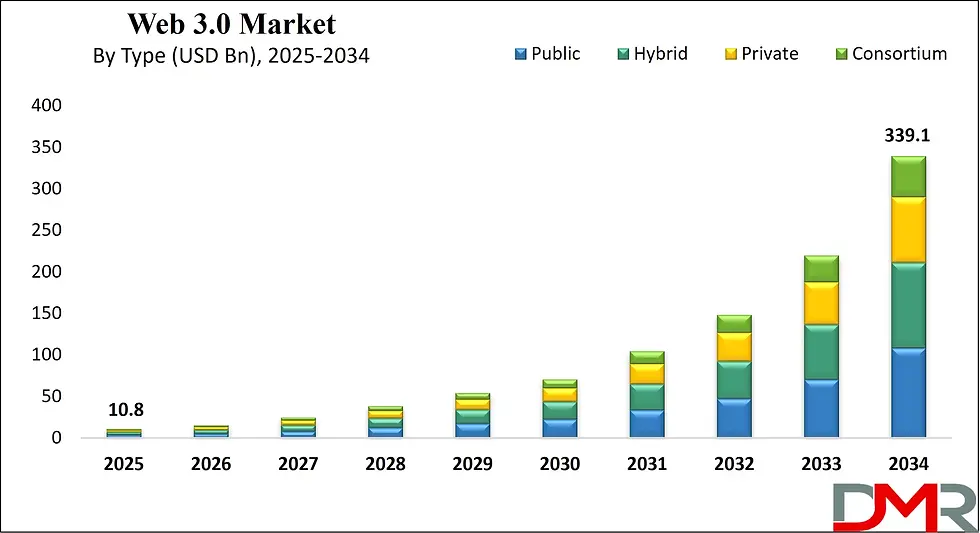
According to Dimension Market Research, the Global Web 3.0 Market size is projected to reach USD 10.8 billion in 2025 and grow at a compound annual growth rate of 46.6% from there until 2034 to reach a value of USD 339.1 billion. The market is witnessing explosive growth due to the rising demand for data privacy and ownership, rapid advancements in blockchain technology, growing adoption of decentralized applications, and the increasing tokenization of real-world assets.
Web 3.0, also called the decentralized web, is the next generation of internet technology that focuses on giving users more control over their data and digital identity. Unlike Web 2.0, where major platforms control content and user data, Web 3.0 uses blockchain and peer-to-peer networks to create a more open and user-driven internet. This version of the web aims to reduce reliance on big tech companies and make the internet more democratic, secure, and transparent.
The demand for Web 3.0 has been growing steadily. As users become more aware of data privacy issues, they are seeking platforms where they own their personal data. At the same time, the rise of cryptocurrencies, smart contracts, and decentralized finance (DeFi) has shown the potential of blockchain in creating a trustless and permissionless internet.
Startups and tech giants are both exploring how to build Web 3.0 products such as decentralized social networks, marketplaces, and cloud services. This growth is also intertwined with advancements in digital adoption platform technologies that simplify user onboarding, and open-source intelligence tools that strengthen security and trust in decentralized ecosystems.
Definition and Market Significance
Web 3.0 refers to the next generation of internet technology built on blockchain, peer-to-peer networks, and decentralized protocols that give users greater control over their data, digital identity, and online interactions. It encompasses decentralized applications (dApps), cryptocurrencies, smart contracts, digital identity systems, and token-based economies.
The importance of Web 3.0 lies in its ability to address key limitations of the current internet, including data centralization, privacy concerns, and platform control. By enabling user-owned data and decentralized governance, Web 3.0 promotes transparency, security, and digital sovereignty.
Web 3.0 also supports broader economic and social objectives by enabling financial inclusion, empowering creators through direct monetization, and fostering innovation in decentralized finance, digital identity, and immersive digital experiences.
Looking for Something Specific? Get Free Sample:
Market Drivers
A major factor driving the Web 3.0 Market is the rising demand for data privacy and ownership. One of the strongest growth drivers for the Web 3.0 market is the increasing global concern over data privacy and digital rights. Users are becoming more aware of how their personal information is collected, stored, and sold by traditional platforms. Web 3.0 offers a solution through decentralized systems that allow individuals to control their own data. As public trust in big tech companies continues to decline, interest in self-owned digital identities and decentralized services is likely to grow significantly.
Rapid advancements in blockchain technology and tools is another key driver supporting market expansion. The rapid improvement of blockchain infrastructure, tools, and developer ecosystems is fueling Web 3.0 innovation. Faster blockchains, better smart contract platforms, and scalable solutions like layer-2 networks are making it easier to build and run decentralized applications. As these technologies mature, the foundation for Web 3.0 becomes stronger, driving wider use across industries.
The growing adoption of decentralized finance, NFTs, and metaverse platforms is also contributing to market growth, as users and businesses increasingly recognize the value of decentralized, user-owned digital ecosystems.
Market Trends
The integration of decentralized AI with blockchain networks is emerging as an important trend in the Web 3.0 market. A major trend is the merging of decentralized AI with blockchain networks. This creates systems where AI models run on transparent, permissionless platforms—ensuring users keep control of their data during model training and usage. As these systems evolve, Web 3.0 becomes more adaptive, automated, and trustworthy for diverse applications.
Another significant trend is the tokenization of real-world assets and the expansion of decentralized physical infrastructure networks (DePIN). Tokenization allows fractional ownership and 24/7 global trading of physical assets like real estate, art, and commodities. DePIN networks let individuals contribute resources and earn tokens in return, pushing Web 3.0 toward real-world integration and community-driven infrastructure.
The growth of decentralized social media, digital identity ownership, and smart contract automation is also transforming the market, enabling new forms of online interaction and economic participation.
Market Restraints
Despite its strong growth potential, the Web 3.0 Market faces certain limitations. Lack of user awareness and complex user experience pose significant restraints. One of the major restraints of the Web 3.0 market is the limited awareness and understanding among general users. Many people are still unfamiliar with how blockchain works or how to interact with decentralized platforms. The user experience on most Web 3.0 applications is still far from seamless, often requiring technical knowledge to set up wallets, manage private keys, or use tokens.
Regulatory uncertainty and legal challenges are another significant restraint. Many governments are still developing their policies regarding blockchain, digital currencies, and decentralized platforms. This uncertainty creates hesitation among businesses and investors, who fear legal risks or sudden changes in compliance rules. Without clear global standards or supportive regulations, Web 3.0 platforms face challenges in scaling across borders.
In addition, security concerns, including hacks and scams, can undermine user trust and slow adoption.
Market Opportunities
The expansion into emerging markets and digital inclusion presents significant growth opportunities. Web 3.0 presents a major opportunity to drive digital inclusion in emerging markets where traditional financial systems and digital infrastructure are limited. Decentralized platforms can provide access to financial services, identity verification, and secure communication without the need for intermediaries. As mobile usage grows in underserved regions, Web 3.0 tools can bridge digital gaps and unlock new user bases across the world.
Growth in decentralized applications and the creator economy is another promising opportunity. The rise of decentralized applications (dApps) offers huge potential for reshaping how digital content, services, and communities are built and monetized. Web 3.0 enables creators to earn directly from their work without relying on middlemen or platforms that take large commissions. As tools for building and launching dApps become more accessible, the number and diversity of Web 3.0 use cases will expand rapidly.
Furthermore, the tokenization of real-world assets and the growth of DePIN networks are expected to open new opportunities for Web 3.0 providers.
Segmentation
The Web 3.0 Market is categorized based on type, application, and end use.
By type, the public segment is expected to lead the market in 2025 with a share of 31.8%, driven by growing interest in open-source platforms, decentralized applications, and blockchain-based public networks. The private segment is gaining attention for its focus on security, compliance, and controlled access within Web 3.0 environments.
By application, the cryptocurrency segment is expected to lead the market in 2025 with a share of 35.7%, playing a central role in shaping the decentralized internet. The payments segment is emerging as a key driver in the adoption of Web 3.0 solutions, offering faster, cheaper, and more transparent alternatives to traditional systems.
By end use, the retail and e-commerce segment is set to lead the market in 2025 with a projected share of 40.2%, driven by increasing demand for personalized, secure, and decentralized shopping experiences. The media and entertainment segment is playing a vital role in accelerating Web 3.0 adoption through NFTs, creator monetization, and immersive experiences.
Regional Analysis
North America is leading the Web 3.0 market in 2025 with an estimated share of 43.2%, driven by strong technological infrastructure, high digital adoption, and growing interest in decentralized platforms. The region's progress is backed by active participation from tech startups, financial institutions, and blockchain developers who are building innovative solutions in areas like decentralized finance (DeFi), digital identity, and smart contracts. Supportive venture capital activity and a large base of early adopters further strengthen the region's position. The US market is projected to reach USD 4.0 billion in 2025 at a CAGR of 43.6%.
Europe holds a strategic and influential role in the Web 3.0 market, especially in shaping regulation, digital rights, and ethical technology use. The region is focused on creating a safe, transparent, and privacy-focused digital ecosystem, supported by policies like the GDPR and the Markets in Crypto-Assets (MiCA) regulation. The market is projected to reach USD 2.4 billion in 2025 at a CAGR of 42.9%.
Asia Pacific is showing significant growth in the Web 3.0 market over the forecast period, supported by rising digital adoption, strong developer communities, and government interest in blockchain innovation. Countries across the region are exploring use cases in decentralized finance (DeFi), NFTs, and smart contracts, while also encouraging investments in metaverse platforms and token-based economies. Japan's market is projected to reach USD 600 million in 2025 at a CAGR of 50.5%.
Latin America and the Middle East & Africa are gradually adopting Web 3.0 technologies as digital infrastructure improves and awareness of decentralized platforms grows, with Brazil, Mexico, the UAE, and Saudi Arabia emerging as key markets.
Competitive Landscape
The Web 3.0 market is highly competitive and rapidly evolving, with many players working to shape the future of a decentralized internet. The landscape includes blockchain developers, infrastructure providers, decentralized app creators, and digital wallet platforms. Competition is strong as each aims to offer faster, safer, and more user-friendly tools and services. Innovation is key, with companies racing to build platforms that allow users to control their data, trade digital assets, or interact in virtual environments.
Prominent players include OpenSea, Coinbase, Binance, Crypto.com, Polygon, Solana, Immutable, Hedera, Gemini, Ripple, Chainalysis, Consensys, MetaMask, Uniswap, LayerZero, Magic Eden, FalconX, Matter Labs (zkSync), Pagoda (NEAR tools), and OKX. Recent developments include MetaEra's pre-A round of financing (April 2025), WiSA Technologies' acquisition of Datavault and ADIO's IP and IT assets (January 2025), Ducati's entry into Web 3.0 through a partnership with NFT PRO and Ripple (September 2024), and Tarento Technologies' partnership with Dhiway (August 2024).
Technological Advancements
Rapid advancements in blockchain scalability, layer-2 networks, smart contract platforms, and decentralized identity solutions are transforming the Web 3.0 market. These technologies enable faster, cheaper, and more secure transactions, making decentralized applications more practical for everyday use.
The integration of AI with blockchain and decentralized systems is also playing a significant role, enabling smarter, more personalized, and more secure digital experiences across Web 3.0 platforms.
Consumer Adoption Patterns
Consumers and enterprises are increasingly adopting Web 3.0 technologies for applications such as decentralized finance, digital identity, NFTs, decentralized social media, and tokenized assets. The growing availability of user-friendly wallets, dApps, and blockchain platforms is expanding adoption across diverse user segments.
Regulatory Environment
Regulatory frameworks across different regions, including MiCA in Europe, evolving SEC guidance in the United States, and various national blockchain strategies, significantly influence the Web 3.0 market. Compliance with these regulations is essential for market participants and shapes the pace of adoption and innovation.
Market Challenges
The Web 3.0 market faces challenges related to limited user awareness, complex user experience, regulatory uncertainty, security concerns, and the need for scalable and interoperable infrastructure. Additionally, the rapid pace of technological change requires continuous investment in R&D and user education.
Future Outlook
The future of the Web 3.0 Market remains exceptionally promising as decentralized technologies continue to mature and user awareness grows. Increasing adoption of decentralized applications, tokenization of real-world assets, integration of AI with blockchain, and expansion into emerging markets are expected to drive strong market growth during the forecast period, with the market projected to reach USD 339.1 billion by 2034 at a CAGR of 46.6%.
FAQs
What is the expected size of the Web 3.0 Market in 2025?
The market is expected to reach USD 10.8 billion in 2025.
What is the projected market value by 2034?
The market is forecast to reach USD 339.1 billion by 2034.
What is the CAGR of the Web 3.0 Market?
The market is expected to grow at a CAGR of 46.6% during 2025–2034.
Which type segment dominates the market?
The public segment is expected to lead with 31.8% share in 2025.
Which region leads the global Web 3.0 market?
North America is leading with an estimated 43.2% share in 2025.
Summary of Key Insights
The global Web 3.0 Market is expected to grow from USD 10.8 billion in 2025 to USD 339.1 billion by 2034, recording a CAGR of 46.6% during the forecast period. The public segment leads the type segment with 31.8% share, while cryptocurrency leads applications with 35.7% share. Retail and e-commerce leads end-use demand with 40.2% share. North America holds the largest regional share with 43.2% of global revenue in 2025, while Asia Pacific is projected as the fastest-growing region. The US market is projected to reach USD 4.0 billion in 2025 at a CAGR of 43.6%.
Purchase the Full Report

Comments