


Digital Tokens Market Size to Hit USD 102.0 billion by 2034

Market Overview
According to Dimension Market Research, the Global Digital Tokens Market is anticipated to reach USD 16.1 billion in 2025, driven by advancements in blockchain technology, decentralized finance (DeFi), and tokenized real-world assets (RWAs). The market is expected to expand at a robust compound annual growth rate (CAGR) of 22.8% from 2025 to 2034, reaching a projected value of USD 102.0 billion by 2034.
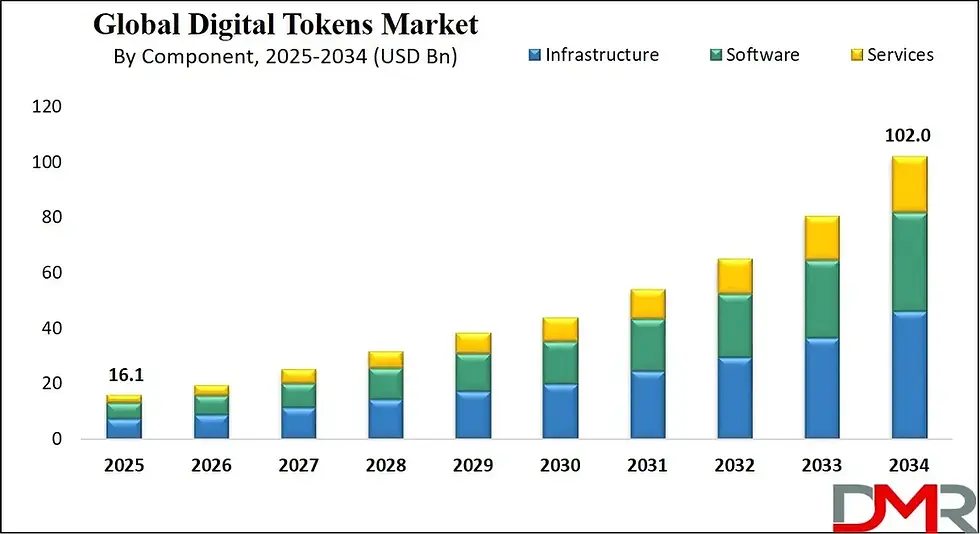
Growth is fueled by the increasing adoption of AI-driven smart contracts and automated market makers, rising demand for digital securities and utility tokens, and the integration of tokenization in traditional finance and supply chain management. Additionally, expanding applications in payments, asset management, and identity verification sectors, coupled with the growing availability of scalable blockchain protocols and regulatory-compliant token standards, are expected to further accelerate market expansion globally.
The global landscape for digital tokens is experiencing a profound transformation, moving beyond cryptocurrencies into the core of digital asset ecosystems and institutional finance. A significant trend is the shift towards institutional-grade tokenization, where financial institutions are establishing in-house digital asset divisions to create and manage tokenized securities and funds. This decentralization of financial services accelerates transaction settlements and improves asset liquidity by providing fractional ownership of previously illiquid assets.
Concurrently, the technology is advancing into central bank digital currencies (CBDCs), where research and pilot programs focus on creating sovereign digital money, though this remains largely in the developmental and regulatory phase. The integration of artificial intelligence with token issuance platforms is also emerging, optimizing token economics and automating compliance processes through smart contracts.
Definition and Market Significance
Digital tokens are programmable digital assets built on blockchain technology that represent ownership, access rights, or utility within a specific ecosystem. Unlike cryptocurrencies like Bitcoin, which primarily serve as a store of value or medium of exchange, digital tokens encompass a broader spectrum of assets including security tokens (representing ownership in traditional assets), utility tokens (providing access to products or services), stablecoins (pegged to fiat currencies), and non-fungible tokens (NFTs) representing unique digital items.
The significance of digital tokens lies in their capacity to democratize access to financial assets, improve liquidity through fractional ownership, and automate compliance through embedded smart contracts. They enable near-instantaneous settlement of transactions, reduce counterparty risk, and create new financial products that were previously impossible or economically unviable.
Digital tokens also support broader financial transformation by enabling programmable money, automated compliance, and the creation of decentralized financial ecosystems that operate without traditional intermediaries, potentially lowering costs and increasing access to financial services globally.
Request a Complimentary PDF Sample:
Market Drivers
A primary factor propelling the Digital Tokens Market is institutional adoption and financial modernization. The global trend of financial institutions exploring and adopting digital assets is a primary driver for the digital tokens market. Major banks, asset managers, and custodians are developing infrastructure to support the tokenization of traditional assets and the trading of digital tokens. This modernization is driven by the need for operational efficiency, reduced settlement times, and access to new asset classes and revenue streams.
Supportive regulatory frameworks and industry standards serves as another key driver supporting market expansion. The gradual establishment of clearer regulatory pathways by major agencies, such as the EU's MiCA, and guidance from the SEC and CFTC in the U.S., has provided growing clarity for businesses to invest in the sector. These frameworks aim to validate the legality and operational safety of digital token activities, accelerating their integration into the mainstream financial system.
Substantial investment from venture capital and corporate R&D directly fuels foundational research and development in blockchain scalability, security, and interoperability. This financial and regulatory support de-risks innovation and catalyzes the transition of digital tokens from a niche technology to a core component of the future financial infrastructure.
Market Trends
Institutional-grade tokenization is surfacing as a dominant trend in the digital tokens market. A dominant trend is the migration of tokenization directly into the core systems of large financial institutions, establishing dedicated digital asset divisions. This shift enables the rapid creation and management of tokenized versions of traditional securities, funds, and alternative assets on demand, leading to reduced settlement times, decreased counterparty risk, and the creation of new, programmable financial products.
Another significant trend is interoperability and cross-chain development. The industry is witnessing rapid innovation in the development of novel protocols and standards aimed at enabling seamless communication and transfer of value between different blockchain networks. This includes the creation of cross-chain bridges, interoperable token standards, and layer-2 scaling solutions that enhance transaction throughput and reduce fees.
The integration of artificial intelligence with token issuance platforms is also reshaping the market, optimizing token economics and automating compliance processes through smart contracts. Concurrently, significant research is focused on zero-knowledge proofs and other privacy-enhancing technologies for transactions, expanding the application horizon from isolated blockchain ecosystems to a cohesive, interconnected internet of value.
Market Restraints
Despite its strong growth potential, the digital tokens market encounters certain limitations. Regulatory uncertainty and compliance costs pose significant challenges. The fragmented and evolving global regulatory landscape presents a major barrier to entry and scaling, particularly for startups and cross-border services. Navigating different legal classifications, licensing requirements, and anti-money laundering rules across jurisdictions requires significant legal expertise and financial resources.
Security risks and technical complexity is another significant restraint. The effective implementation and custody of digital tokens require a deep understanding of cybersecurity, cryptography, and distributed systems. There is a pronounced shortage of professionals trained in this niche intersection, creating a significant human resource bottleneck. The prevalence of hacks, smart contract vulnerabilities, and private key management challenges further exacerbates this challenge.
Additionally, the total cost of operation includes ongoing reporting, auditing, and the implementation of sophisticated monitoring systems, which can slow down widespread adoption and require demonstrable proof of robust compliance to secure banking partnerships.
Market Opportunities
The expansion in tokenized real-world assets (RWAs) presents a significant growth opportunity. The tokenization of real-world assets represents one of the largest and most rapidly expanding opportunities. The technology is ideal for representing ownership of a wide array of illiquid assets with high precision and efficiency, including real estate, private equity, debt instruments, and commodities. The shift from traditional paper-based and centralized record-keeping to blockchain-based digital tokens offers significant gains in transparency, fractional ownership, and market liquidity.
Decentralized finance (DeFi) and automated financial services is another promising opportunity. A nascent but high-potential growth frontier lies in the decentralized finance sector, where digital tokens are being used to create automated, non-custodial financial protocols. This technology enables the creation of complex financial instruments like lending pools, derivatives, and asset management strategies that execute automatically via smart contracts, potentially lowering costs and increasing access globally.
Furthermore, the development of novel, interoperable token standards and privacy-focused tokens opens new avenues for creating financial products that integrate better with global regulatory frameworks, addressing complex challenges in capital markets and trade finance.
Segmentation
The Digital Tokens Market is categorized based on component, technology, token type, application, and end-user.
By component, the Infrastructure segment is projected to be the foundational and currently dominant component, with Blockchain Protocols & Networks as its core. This dominance is driven by the critical need for secure, scalable, and reliable distributed ledgers that form the bedrock upon which all digital tokens are issued, transferred, and stored.
By technology, Public/Permissionless Blockchains are expected to dominate in terms of innovation, developer activity, and total economic value secured. Their supremacy stems from core principles of open access, censorship resistance, and decentralization, which foster unparalleled innovation and network effects.
By token type, Payment Tokens & Stablecoins are projected to be the undisputed leader by daily transaction volume, user base, and their role as the primary medium of exchange. Stablecoins, in particular, have become the lifeblood of the market, offering the price stability of fiat currency with the efficiency of a digital asset.
By application, Payments & Remittances is expected to be the dominant sub-segment in terms of real-world utility and transaction volume, anchored in its ability to solve the inefficiency of traditional cross-border money transfers.
By end-user, Cryptocurrency Exchanges & Trading Venues are poised to be the dominant sub-segment, acting as the central nervous system of the entire digital token market and the primary gateways for capital entry and liquidity hubs for trading activity.
Regional Analysis
North America, led by the United States, is projected to command the largest share of the global digital tokens market with 40.0% of market share by the end of 2025, due to a powerful confluence of technological leadership, deep capital markets, and a dynamic regulatory environment. The region is home to many of the world's leading digital asset companies, such as Coinbase, Circle, and Ripple, which continuously drive innovation in both infrastructure and tokenized assets. The US market is projected to reach USD 5.4 billion in 2025 at a CAGR of 21.4%.
Europe holds a substantial share of the digital tokens market, estimated to be valued at USD 1.9 billion in 2025 and anticipated to reach USD 8.1 billion by 2034 at a CAGR of 16.5%. The European ecosystem is characterized by strong collaboration between public regulators, central banks, and industry, guided by a comprehensive regulatory framework including the new Markets in Crypto-Assets (MiCA) regulation.
Asia Pacific is expected to exhibit the highest Compound Annual Growth Rate (CAGR) in the digital tokens market, fueled by massive digitalization, government-led blockchain initiatives, and a vast, tech-savvy population. Countries like Singapore, Japan, and South Korea are making substantial public and private investments in blockchain technology as a core part of their digital economy strategies. Japan's market is projected to reach USD 3,550 million in 2034 at a CAGR of 18.1%.
Competitive Landscape
The competitive landscape of the global digital tokens market is fragmented and highly dynamic, characterized by a mix of established cryptocurrency giants, specialized fintech firms, and a vibrant ecosystem of innovative startups and DeFi protocols. Dominant players like Coinbase Global, Inc., Binance Holdings Ltd., and Circle Internet Financial Ltd. leverage their extensive user bases, regulatory licenses, and robust technology platforms to maintain a stronghold, particularly in the realms of trading, custody, and stablecoin issuance.
Prominent players include Coinbase Global, Inc., Binance Holdings Ltd., Ripple, Circle Internet Financial Ltd., ConsenSys Software Inc., Digital Asset Holdings, LLC, Blockdaemon Inc., Fireblocks, Anchorage Digital, Paxos Trust Company, LLC, Gemini Trust Company, LLC, Kraken, BitGo, Inc., Ledger, Algorand Inc., Stellar Development Foundation, and Hedera.
Recent developments include MAS's launch of its first live issuances of digital bonds under Project Guardian (May 2024), BlackRock's launch of a tokenized money market fund (April 2024), the EBA's direct supervision of Crypto-Asset Service Providers under MiCA (March 2024), and a consortium of major banks completing a proof-of-concept for tokenizing alternative assets (February 2024).
Technological Advancements
Rapid advancements in blockchain scalability, interoperability protocols, and privacy-enhancing technologies are transforming the digital tokens market. The development of layer-2 scaling solutions and cross-chain bridges enables seamless communication and value transfer between different blockchain networks, while zero-knowledge proofs enhance transaction privacy.
The integration of AI with token issuance platforms and smart contract automation is also playing a significant role, optimizing token economics, automating compliance, and enabling more sophisticated financial products. The emergence of institutional-grade custody solutions and regulatory-compliant token standards further accelerates market growth.
Consumer Adoption Patterns
Cryptocurrency exchanges, financial institutions, institutional investors, retail users, technology companies, and government entities are increasingly adopting digital tokens for payments, asset tokenization, DeFi applications, and digital identity management. The growing availability of user-friendly wallets, trading platforms, and regulatory-compliant services is making digital tokens more accessible to a broader range of users.
Regulatory Environment
Regulatory frameworks across different regions significantly influence the digital tokens market. The EU's MiCA regulation, SEC and CFTC guidance in the U.S., and initiatives like Singapore's Project Guardian provide varying levels of clarity and compliance requirements. Regulatory developments shape market structure, investor protection, and the pace of institutional adoption.
Market Challenges
The digital tokens market faces challenges related to regulatory uncertainty, security risks, technical complexity, compliance costs, and the shortage of skilled professionals. Additionally, the fragmentation of regulatory approaches across jurisdictions and the need for robust custody solutions create operational challenges for market participants.
Future Outlook
The future of the Digital Tokens Market remains exceptionally promising as institutional adoption accelerates, regulatory clarity improves, and technological innovations continue to expand the capabilities of digital tokens. Increasing tokenization of real-world assets, growth of DeFi applications, and integration of AI and blockchain technologies are expected to drive strong market growth during the forecast period, with Asia Pacific emerging as the fastest-growing region.
FAQs
What is the expected size of the Digital Tokens Market in 2025?
The market is expected to reach USD 16.1 billion in 2025.
What is the projected market value by 2034?
The market is forecast to reach USD 102.0 billion by 2034.
What is the CAGR of the Digital Tokens Market?
The market is expected to grow at a CAGR of 22.8% during 2025–2034.
Which token type dominates the market?
Payment Tokens & Stablecoins are projected to lead by daily transaction volume and user base.
Which region leads the global digital tokens market?
North America is projected to command the largest share with 40.0% by the end of 2025.
Summary of Key Insights
The global Digital Tokens Market is expected to grow from USD 16.1 billion in 2025 to USD 102.0 billion by 2034, recording a CAGR of 22.8% during the forecast period. Infrastructure leads the component segment, while Public/Permissionless Blockchains dominate technology. Payment Tokens & Stablecoins lead token types, Payments & Remittances lead applications, and Cryptocurrency Exchanges lead end-user demand. North America holds the largest regional share with 40.0% of global revenue in 2025, while Asia Pacific is projected as the fastest-growing region. The US market is projected to reach USD 31.1 billion by 2034 at a CAGR of 21.4%.
Purchase the Full Report
Comments