


Observability Platform Market Size, Trends & Forecast 2035

Market Overview
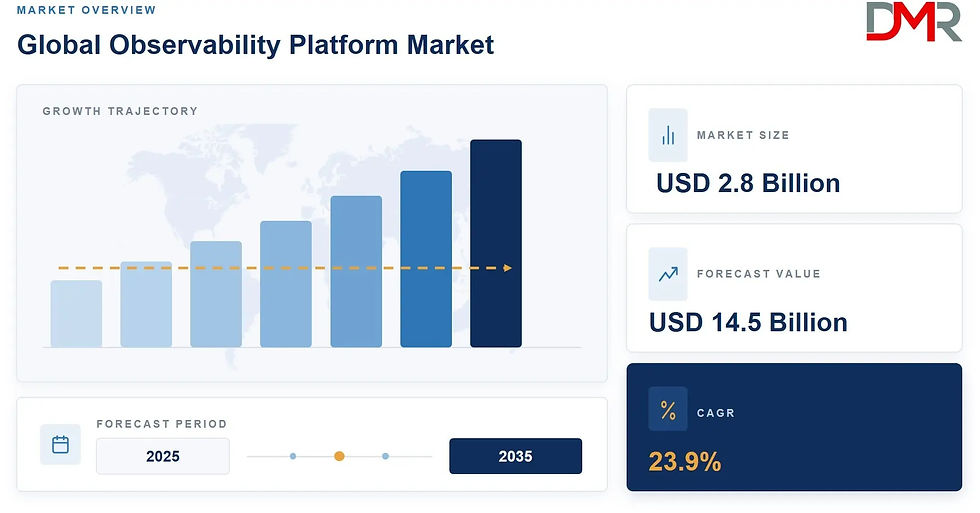
According to Dimension Market Research, the Global Observability Platform Market Size is projected to be valued at USD 2.8 billion in 2026 and is projected to reach USD 14.5 billion by 2035, expanding at a CAGR of 23.9% during the forecast period. Growth is being driven by increasing cloud complexity, rapid adoption of microservices and containerized applications, and rising demand for real-time infrastructure monitoring.
The Observability Platform market refers to a suite of tools and services that help organizations collect, correlate, analyze, and visualize telemetry data—metrics, logs, and traces—from their IT infrastructure, applications, and distributed systems. These platforms enable real-time visibility, root-cause analysis, and proactive monitoring, which are critical as enterprises increasingly operate complex digital environments with cloud, microservices, containers, and hybrid infrastructures. Traditional monitoring methods are no longer sufficient to manage these dynamic and distributed systems.
Enterprises are increasingly deploying observability platforms to improve application performance, identify system failures, strengthen security, reduce downtime, and optimize IT operations. Growing cloud-native architectures, DevOps adoption, and digital transformation initiatives are further accelerating demand across industries worldwide.
The market is also being shaped by the growing convergence of observability with AIOps and security, the shift toward unified full-stack observability platforms, and the increasing adoption of hybrid and multi-cloud deployment models.
Definition and Market Significance
Observability platforms are integrated software solutions and services that enable organizations to collect, correlate, analyze, and visualize telemetry data—including metrics, logs, and traces—from applications, infrastructure, and distributed systems. These platforms provide real-time visibility into system health, performance, and dependencies, enabling proactive issue detection, rapid root-cause analysis, and optimized IT operations.
The importance of observability platforms lies in their ability to provide comprehensive visibility across increasingly complex, dynamic, and distributed IT environments. As enterprises adopt cloud-native architectures, microservices, containers, and hybrid infrastructures, traditional monitoring tools struggle to provide adequate visibility, making observability platforms essential.
Observability platforms also support broader digital transformation objectives by enabling faster software delivery, improving application reliability, strengthening security posture, and facilitating data-driven decision-making across DevOps, SRE, and IT operations teams.
Request a Complimentary PDF Sample
Market Drivers
A major factor driving the Observability Platform Market is the rising complexity of cloud-native and distributed IT environments. Rapid adoption of cloud computing, microservices, containers, Kubernetes, serverless architectures, and distributed applications is increasing the complexity of enterprise IT environments. Traditional monitoring tools often struggle to provide complete visibility across interconnected systems. Observability platforms address this challenge by integrating logs, metrics, traces, and application data into unified environments.
The growing adoption of DevOps, SRE, and digital transformation initiatives is another key driver supporting market expansion. Enterprises are increasingly adopting DevOps and Site Reliability Engineering practices to accelerate software delivery while maintaining application performance and reliability. Observability platforms enable development and operations teams to continuously monitor applications, identify performance bottlenecks, investigate incidents, and improve system resilience.
Rising demand for real-time visibility, cybersecurity concerns, and the need for improved application performance and reliability are also contributing to market growth, as organizations invest in advanced observability capabilities to support mission-critical digital services.
Market Trends
The shift toward unified and full-stack observability platforms is emerging as an important trend in the market. Enterprises are increasingly moving away from fragmented monitoring tools toward unified observability platforms capable of integrating application, infrastructure, network, database, log, metric, and trace data. Full-stack observability provides broader visibility into dependencies across increasingly distributed technology environments and helps teams correlate performance issues more effectively.
Another significant trend is the growing convergence of observability, AIOps, and security. Observability platforms are increasingly converging with AIOps and cybersecurity capabilities as enterprises seek integrated visibility across performance, reliability, and security operations. Advanced analytics and machine learning are being used to correlate telemetry data, detect abnormal behavior, prioritize incidents, and identify potential security threats.
The integration of AI and Generative AI capabilities—including natural-language querying, automated incident summaries, and intelligent troubleshooting recommendations—is also transforming the market, enabling more autonomous and efficient IT operations.
Market Restraints
Despite its strong growth potential, the Observability Platform Market faces certain limitations. High implementation complexity and growing data management costs pose significant challenges. Implementing comprehensive observability platforms can involve substantial costs related to software subscriptions, data ingestion, storage, integration, and skilled personnel. Enterprises generating large volumes of telemetry data may experience rapidly increasing expenses as applications and infrastructure scale.
Integrating observability solutions with legacy systems, multiple cloud environments, and existing monitoring tools can also create technical complexity. These challenges particularly affect smaller organizations with limited IT budgets and expertise, potentially restricting widespread adoption of advanced observability platforms.
In addition, the shortage of skilled personnel capable of managing complex observability environments and the need for continuous investment in platform optimization can slow adoption.
Market Opportunities
The expansion of AI and Generative AI-powered observability presents significant growth opportunities. Integration of artificial intelligence and Generative AI creates significant opportunities for observability platform providers. AI-powered capabilities can automate anomaly detection, incident correlation, root cause analysis, and predictive performance management across complex environments. Generative AI further enables natural-language queries, automated incident summaries, intelligent troubleshooting recommendations, and conversational interfaces.
The growing adoption among SMEs and emerging digital businesses is another promising opportunity. Small and medium-sized enterprises represent a significant growth opportunity as cloud adoption, SaaS applications, e-commerce platforms, and digital services expand across this segment. Cloud-based observability solutions with flexible subscription models can provide SMEs with enterprise-grade monitoring capabilities without substantial infrastructure investment.
Furthermore, the expansion of industry-specific observability solutions for financial services, healthcare, manufacturing, and telecommunications is expected to open new opportunities for observability platform providers.
Segmentation
The Observability Platform Market is categorized based on component, deployment mode, organization size, application, and end user.
By component, solutions are projected to lead the offering segment with a 72.5% share in 2026, driven by demand for unified metrics, logs, traces, and full-stack visibility across cloud-native environments. Services recorded the fastest growth as enterprises increasingly adopted consulting, integration, and managed services to address deployment complexity, skill shortages, and cost optimization.
By deployment mode, cloud dominated the market with a 64.9% share in 2026, supported by SaaS adoption, scalability, rapid deployment, and integration with DevOps workflows. Hybrid deployment recorded the fastest growth as enterprises sought unified visibility across cloud and on-premises environments while maintaining flexibility and regulatory compliance.
By organization size, large enterprises dominated with a 63.3% share in 2026, driven by complex IT environments and strong requirements for reliability and performance. SMEs recorded the fastest growth, supported by affordable SaaS platforms, open-source tools, simplified pricing, and managed services.
By application, application performance monitoring dominated with a 31.8% share in 2026, driven by demand for improved user experience, reliability, and faster troubleshooting. Security and compliance monitoring recorded the fastest growth as organizations increasingly adopted real-time anomaly detection, incident response, and integrated security observability capabilities.
By end user, IT and telecom led with a 30.3% share in 2026, supported by demand for network visibility, application uptime, and reliable digital services. Manufacturing recorded the fastest growth, driven by Industry 4.0, IoT, smart factories, predictive monitoring, and integration of IT and operational technology systems.
Regional Analysis

North America is expected to dominate this market as it is poised to account for 38.5% of the global market in 2026. This leadership is supported by widespread cloud adoption, advanced digital infrastructure, strong penetration of DevOps and cloud-native technologies, and significant enterprise spending on IT monitoring. Growing deployment of microservices, containers, AI-driven operations, and cybersecurity solutions, alongside the strong presence of major observability platform providers, continues to strengthen regional market growth. The US market is projected to reach USD 1.1 billion in 2026.
Europe is experiencing strong growth, supported by accelerating cloud migration, enterprise digital transformation, and increasing adoption of microservices and containerized applications. Organizations are deploying observability platforms to improve application reliability, infrastructure visibility, cybersecurity, and operational efficiency. Stringent data protection requirements are also encouraging secure monitoring practices, with expanding DevOps adoption, hybrid cloud environments, and AI-driven analytics strengthening regional market development.
Asia Pacific is expected to record the fastest growth, with a CAGR of approximately 25.0% during the forecast period. Growth is supported by rapid cloud adoption, expanding digital transformation initiatives, increasing deployment of microservices, and rising investments in IT infrastructure. Growing adoption of DevOps practices, AI-driven monitoring, e-commerce platforms, and cloud-native applications across China, India, Japan, and Southeast Asia is further accelerating demand. Japan's market is expanding as enterprises modernize legacy IT environments and accelerate cloud transformation.
Latin America is expanding as enterprises accelerate cloud migration, digital transformation, and modernization of legacy IT infrastructure. Growing adoption of e-commerce, fintech, telecommunications, and digital banking services is increasing demand for real-time application and infrastructure visibility. The Middle East and Africa market is expanding with accelerating cloud adoption, digital transformation programs, and modernization of enterprise IT infrastructure, with Saudi Arabia gaining momentum as government and private enterprises accelerate digital transformation.
Competitive Landscape
The Global Observability Platform Market is moderately consolidated, with vendors competing through full-stack visibility, AI-driven analytics, cloud-native monitoring, OpenTelemetry integration, automation, security observability, and scalable deployment. Major participants include Datadog, Dynatrace, New Relic, Cisco, Splunk, Elastic, Microsoft, Google, Amazon Web Services, ScienceLogic, and LogicMonitor.
Competitive differentiation increasingly centers on unified telemetry, automated root cause analysis, generative AI capabilities, flexible pricing, multi-cloud support, integrations, and managed services that improve enterprise application reliability and operational efficiency.
Prominent players include Datadog, Inc., Dynatrace, Inc., New Relic, Inc., Cisco Systems, Inc., Elastic N.V., Grafana Labs, Amazon Web Services, Inc., Microsoft Corporation, Google LLC, IBM Corporation, Oracle Corporation, BMC Software, Inc., LogicMonitor, Inc., ScienceLogic, Inc., SolarWinds Corporation, Sumo Logic, Inc., Honeycomb.io, Coralogix Ltd., Apica, ITRS Group, Palo Alto Networks, Inc., ServiceNow, Inc., Logz.io, Better Stack, Axiom, SigNoz, groundcover, AppSignal, Dash0, Alibaba Cloud, Hewlett Packard Enterprise, ManageEngine, Riverbed Technology, Paessler GmbH, Sematext, Netdata, Inc., VictoriaMetrics, Middleware, Last9, and Mezmo, Inc. Recent developments include Grafana Labs' general availability of Adaptive Profiles (August 2026), Dynatrace's positioning as a Leader in the 2026 Gartner Magic Quadrant for Observability Platforms (July 2026), and Datadog's acquisition of Adaptive ML (June 2026).
Technological Advancements
Rapid advancements in artificial intelligence, generative AI, machine learning, OpenTelemetry, cloud-native architectures, and automated incident management are reshaping observability platform capabilities. Vendors are increasingly integrating logs, metrics, traces, application data, and infrastructure telemetry within unified platforms.
AI-driven anomaly detection, predictive analytics, automated root cause analysis, and natural-language querying are improving operational efficiency and reducing resolution times. Opportunities are emerging around autonomous observability, security convergence, and monitoring of AI workloads, while continued technological innovation is intensifying competition and encouraging enterprises to consolidate fragmented monitoring tools into comprehensive observability platforms.
Consumer Adoption Patterns
Enterprises across IT and telecom, BFSI, healthcare and life sciences, retail and e-commerce, manufacturing, and government are increasingly adopting observability platforms to improve application performance, infrastructure visibility, cybersecurity, and operational efficiency. The growing availability of cloud-based and managed observability services is making these platforms more accessible to organizations of all sizes.
Regulatory Environment
Regulatory frameworks across different regions, including GDPR in Europe, various data protection and privacy laws, and industry-specific compliance requirements, significantly influence the observability platform market. Compliance with these regulations drives demand for secure monitoring practices, data governance, and audit-ready observability solutions.
Market Challenges
The observability platform market faces challenges related to high implementation complexity, growing data management costs, skilled workforce shortages, integration complexity with legacy systems, and pricing pressure from open-source alternatives. Additionally, telemetry complexity, data quality issues, and AI accuracy risks remain concerns for enterprises deploying advanced observability capabilities.
Future Outlook
The future of the Observability Platform Market remains exceptionally promising as enterprises continue to adopt cloud-native architectures and prioritize application reliability, security, and operational efficiency. Increasing adoption of AI and Generative AI-powered observability, growth in SME adoption, expansion of hybrid and multi-cloud environments, and convergence of observability with AIOps and security are expected to drive strong market growth during the forecast period, with the market projected to reach USD 14.5 billion by 2035 at a CAGR of 23.9%.
FAQs
What is the expected size of the Observability Platform Market in 2026?
The market is expected to reach USD 2.8 billion in 2026.
What is the projected market value by 2035?
The market is forecast to reach USD 14.5 billion by 2035.
What is the CAGR of the Observability Platform Market?
The market is expected to grow at a CAGR of 23.9% during 2026–2035.
Which component segment dominates the market?
Solutions are projected to lead with a 72.5% share in 2026.
Which region leads the global observability platform market? North America is expected to dominate with a 38.5% share in 2026.
Summary of Key Insights
The global Observability Platform Market is expected to grow from USD 2.8 billion in 2026 to USD 14.5 billion by 2035, recording a CAGR of 23.9% during the forecast period. Solutions lead the component segment with 72.5% share, while cloud deployment dominates with 70.2% share. Large enterprises represent 63.3% of organization size share, application performance monitoring leads applications with 31.8% share, and IT and telecom lead end-user demand with 30.3% share. North America holds the largest regional share with 38.5% of global revenue in 2026, while Asia Pacific is projected as the fastest-growing region at approximately 25.0% CAGR.
Purchase the Full Report https://dimensionmarketresearch.com/checkout/observability-platform-market/
Comments